
By Emily Chong
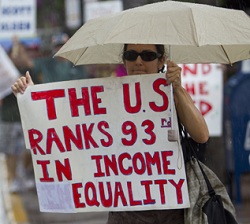 Fast food workers are going on strike from New York to Seattle to demand higher wages, highlighting the never-ending controversy over the consequences of raising the minimum wage. Many news stories seem to suggest that economists have decided a higher minimum wage will cause job loss. However, with more analysis, we undercover the truth: there is no clear link between a higher minimum wage and reduced employment.
John Schmitt, a Senior Economist at the Center for Economic and Policy Research, reported in February 2013 that multiple meta-studies (studies that use statistical techniques to analyze a large amount of separate studies) found that for both older and current studies alike, there is no statistical significance in the effect of an increased minimum wage. Put plainly, if the effect is not statistically significant, then there is no proven effect— increases in the minimum wage do not cause job loss.
Accordingly, a few weeks ago, over 100 economists at organizations ranging from the Center for American Progress to Boston University signed a petition in support of increasing the minimum wage. They present current research from well-established organizations such as the National Bureau of Economic Research that shows there are no negative employment effects from minimum wage increases. This includes the most comprehensive data available, based on the increasingly accurate testing that has occurred as more and more states increase minimum wage levels. Even more importantly, this recent series of studies use cutting-edge econometric techniques to control for extraneous variables such as economic downturns and geographic effects. When economists do that, they find that minimum wage increases do not reduce employment.
Logically, this makes a lot of sense. A higher minimum wage is a win-win situation economically: employees have more money to be consumers and are more productive, while businesses wind up reducing costs in the long run, since they won’t have to spend as much money hiring and training new workers (by analyzing data from five separate studies, economists representing the Political Economy Research Institute found that McDonald’s could easily make up for the costs of a higher minimum wage with a mere five cent price increase on Big Macs). It’s just as Henry Ford realized—when he paid his workers more, they became part of his customer base, making his company even more profitable. Increasing the customer base and expanding customer pockets helps stimulate the entire economy, badly needed in the current recession.
So if we have no evidence linking high wages to job loss, our next question is: are higher wages needed as a poverty reduction tool?
Read More Higher wages won’t increase unemployment! – Salon.com.

 soulbrotherspeaks.com