Charges Dropped Against Martese Johnson, UVA Student Bloodied During Arrest By Alcohol Agents

By Larry O’Dell

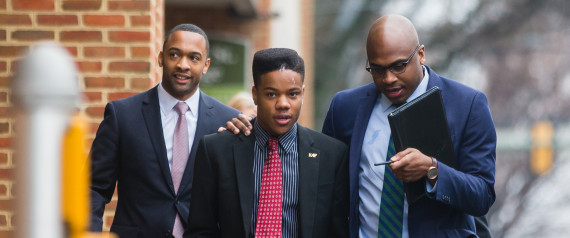
Charges have been dropped against a University of Virginia student whose bloody arrest sparked a public uproar and a state police investigation, a prosecutor said Thursday.

Charlottesville Commonwealth’s Attorney David Chapman said he made the decision after reviewing results of the investigation into Martese Johnson’s arrest. But he said the findings do not warrant charges against the Virginia Alcoholic Beverage Control officers who arrested Johnson.

Chapman said in a written statement that “the interest of justice and the long term interest of the Charlottesville community are best served by using this case as an opportunity to engage ordinary citizens, law enforcement officers, and public officials in constructive dialogue concerning police and citizen relationships in a diverse community.”

Johnson’s attorney, Daniel P. Watkins, said in a telephone interview that his client was “overjoyed” when he learned he will not be prosecuted.

“It’s been our position all along that police lacked justification to arrest and detain Martese,” Watkins said. “It’s been stressful facing criminal prosecution. He’s glad to put this behind him.”

The 20-year-old student form Chicago was arrested outside a bar on March 18 and charged with public intoxication or swearing, and obstruction of justice without force. Chapman will ask a Charlottesville General District Court judge to dismiss those charges at a hearing Friday morning.

Read More  Charges Dropped Against Martese Johnson, UVA Student Bloodied During Arrest By Alcohol Agents.

Posted in News from the Soul Brother | Tagged , , , , , | Leave a comment

Michelle Alexander: “A System of Racial and Social Control”

What is mass incarceration?

Mass incarceration is a massive system of racial and social control. It is the process by which people are swept into the criminal justice system, branded criminals and felons, locked up for longer periods of time than most other countries in the world who incarcerate people who have been convicted of crimes, and then released into a permanent second-class status in which they are stripped of basic civil and human rights, like the right to vote, the right to serve on juries, and the right to be free of legal discrimination in employment, housing, access to public benefits.

It is a system that operates to control people, often at early ages, and virtually all aspects of their lives after they have been viewed as suspects in some kind of crime.

Give me a sense of what’s happened over the last 40 years in terms of the numbers of people in prison, in terms of how it’s affected specific communities, whether it’s very high turnover or people coming on now.

For a very long time, criminologists believed that there was going to be a stable rate of incarceration in the United States. About 100 of 100,000 people were incarcerated, and that rate remained constant up until into the early 1970s. And then suddenly there was a dramatic increase in incarceration rates in the United States, more than a 600 percent increase in incarceration from the mid-1960s until the year 2000.

An exceptional growth in the size of our prison population, it was driven primarily by the war on drugs, a war that was declared in the 1970s by President Richard Nixon and which has increased under every president since. It is a war that has targeted primarily nonviolent offenders and drug offenders, and it has resulted in the birth of a penal system unprecedented in world history.

So America has a higher incarceration rate than other nations. Do they have a higher crime rate than other nations?

No. The United States actually has a crime rate that is lower than the international norm, yet our incarceration rate is six to 10 times higher than other countries’ around the world.

It’s not crime that makes us more punitive in the United States. It’s the way we respond to crime and how we view those people who have been labeled criminals.

You said it started with Nixon. Give me a sense of the progression and how through each president since Nixon the incarceration system has been ramped up, and sometimes in unexpected ways. …

Some of our system of mass incarceration really has to be traced back to the law-and-order movement that began in the 1950s, in the 1960s. …

Segregationists began to worry that there was going to be no way to stem the tide of public opinion and opposition to the system of segregation, so they began labeling people who are engaged in nonviolent civil disobedience and protests as criminals and as lawbreakers, and [they] were saying that those who are violating segregation laws were engaging in reckless behavior that threatens the social order and demanded … a crackdown on these lawbreakers, these civil rights protesters.

This rhetoric of law and order evolved as time went on, even though the old Jim Crow system fell and segregation was officially declared unconstitutional. Segregation[ists] and former segregation[ists] began using get-tough rhetoric as a way of appealing to poor and working-class whites in particular who were resentful of, fearful of many of the gangs of African Americans in the civil rights movement.

Pollsters and political strategists found that thinly veiled promises to get tough on “them,” a group suddenly not so defined by race, was enormously successful in persuading poor and working-class whites to defect from the Democratic New Deal coalition and join the Republican Party in droves.

Unfortunately, this backlash against the civil rights movement was occurring at precisely the same moment that there was economic collapse in communities of color, inner-city communities across America.

In an excellent book by William Julius Wilson, entitled When Work Disappears, he describes how in the ’60s and the ’70s, work literally vanished in these communities. Hundreds of thousands of black people, especially black men, suddenly found themselves jobless.

As factories closed, jobs were shipped overseas, deindustrialization and globalization led to depression in inner-city communities nationwide, and crime rates began to rise. And as they rose and the backlash against the civil rights movement reached a fever pitch, the get-tough movement exploded into a zeal for incarceration, and a war on drugs was declared.

Read More  Michelle Alexander: “A System of Racial and Social Control” | Locked Up In America | FRONTLINE | PBS.

Posted in News from the Soul Brother, Soul Brother Presents | Tagged , , , , , , , | 1 Comment

Coming Home Straight From Solitary Damages Inmates And Their Families

By Joseph Shapiro

The thing Sara Garcia remembers from the day her son, Mark, got out of prison was the hug — the very, very awkward hug. He had just turned 21 and for the past two and a half years, he’d been in solitary confinement.

“He’s not used to anyone touching him,” Garcia says. “So he’s not used to hugs. And I mean we grabbed him. I mean, we hugged him. We held him. I mean, it was just surreal to just know I can finally give him a hug and a kiss on the cheek.”

Mark, who was released directly from solitary confinement into his mother’s arms, is one of tens of thousands of inmates that NPR and The Marshall Project — a journalism group that focuses on the criminal justice system — found as part of a state-by-state survey. We wanted to know: How many people are released directly from solitary confinement to the streets?

There were at least 10,000 in 2014. That’s from information provided by just 24 states. The other 26 states — as well as the federal prison system — say they don’t count, or couldn’t provide, numbers.

Often, inmates in solitary confinement serve all or most of their sentence. So when they are released, they don’t get parole services to help with re-entry that’s offered to most ex-prisoners.

Mental health experts and researchers say that long stays in solitary confinement often emotionally damage people, both teens and adults, and can create lifelong mental illness. When those prisoners come home, they often struggle to get along with people, including the family members they depend upon most.

Prison officials say they need solitary confinement to control the most violent prisoners. In Texas, for example, it’s used often to break up prison gangs.

Garcia’s son went to a Texas prison for robbing a store with a gun. At the time, he was 14. She says that her son was manipulated by some older men; prosecutors say he acted alone.

Read More Coming Home Straight From Solitary Damages Inmates And Their Families : NPR.

Posted in News from the Soul Brother | Tagged , , , , , , | Leave a comment

Questions raised about race of Spokane NAACP head

By Spokane Spokesman-Review

Controversy is swirling around one of the Inland Northwest’s most prominent civil rights activists, with family members of Rachel Dolezal saying the local leader of the NAACP has been falsely portraying herself as black for years.

Dolezal, 37, avoided answering questions directly about her race and ethnicity Thursday, saying, “I feel like I owe my executive committee a conversation” before engaging in a broader discussion with the community about what she described as a “multi-layered” issue.

“That question is not as easy as it seems,” she said after being contacted at Eastern Washington University, where she’s a part-time professor in the Africana Studies Program. “There’s a lot of complexities … and I don’t know that everyone would understand that.”

Later, in an apparent reference to studies tracing the scientific origins of human life to Africa, Dolezal added: “We’re all from the African continent.”

Dolezal is credited with re-energizing the Spokane chapter of the NAACP. She also serves as chairwoman of the city’s Office of Police Ombudsman Commission, where she identified herself as white, black and American Indian in her application for the volunteer appointment, and previously was education director for the Human Rights Institute in Coeur d’Alene.

In recent days, questions have arisen about her background and her numerous complaints to police of harassment. Members of her family are challenging her very identity, saying she has misrepresented major portions of her life.

Dolezal’s mother, Ruthanne Dolezal, said Thursday by phone from her home in Northwest Montana that she has had no contact with her daughter in years. She said her daughter began to “disguise herself” in 2006 or 2007, after the family had adopted four African-American children.

“It’s very sad that Rachel has not just been herself,” Ruthanne Dolezal said. “Her effectiveness in the causes of the African-American community would have been so much more viable, and she would have been more effective, if she had just been honest with everybody.”

Read More Questions raised about race of Spokane NAACP head | The Seattle Times.

Note from SB: I don’t care what race she was born to be as long as she seeks justice and equality for our people. Also, as long as she has been effective as a leader within the NAACP.

Posted in News from the Soul Brother | Tagged , , , , | Leave a comment

The False Promise of Black Political Representation

By Nicholas Stephanopoulos

The recent unrest in Baltimore, Ferguson, and other cities is puzzling in one important respect. Unlike in earlier eras, when African Americans’ political exclusion drove them to protest, blacks today are as likely to vote as whites and are well represented at all levels of government. The mayor of Baltimore and a majority of its city council are black. So are forty-five members of Congress—an all-time high. And, at the other end of Pennsylvania Avenue, so is the current occupant of the White House. Why all the turmoil, then, at a time when blacks—finally—seem to be enjoying the fruits of American democracy?

One answer is that the appearance of black political clout is deceiving. Despite their gains in participation and representation, blacks continue to fare worse than whites in converting their policy preferences into law. This poor performance is more revealing than statistics on turnout or black electoral success. And even though its causes remain mysterious, it is very much a rationale for frustration with the status quo.

In a recent study, I analyzed group political power at the federal and state levels. At the federal level, I relied on a remarkable database compiled by Princeton political scientist Martin Gilens. It includes responses to thousands of survey questions from the last few decades. Crucially, it also tracks whether each policy referred to by a question was adopted by the federal government over the next four years. At the state level, I measured people’s ideologies using exit polls that asked whether they are liberal, moderate, or conservative. And I assessed state laws using an index of overall policy liberalism created by another pair of scholars.

At both levels, I found that blacks hold much less sway than whites. For example, a federal policy with no white support has only a 10 percent chance of being enacted, while one with universal white support has a 60 percent shot of adoption. But while a proposal with no black support has a 40 percent chance of becoming law, one enjoying unanimous approval has only a 30 percent probability of enactment. In other words, as support for a policy rises within the black community, the odds of it being achieved actually decline.

Read More  The False Promise of Black Political Representation – The Atlantic.

Posted in News from the Soul Brother | Tagged , , , , , , , | Leave a comment

Strip club seeks recent high school grads for employment

By Danielle Miller

There are numerous ways to pay for college, some more conventional than others.

For those living in Las Vegas, there’s no shortage of opportunities for fast cash.

“It fits in with Vegas. Vegas is always going to be Vegas,” said Little Darlings manager Rick Marzullo.

Marzullo was talking about ads recently posted outside his strip club, located near Interstate 15 and Charleston Boulevard. One sign reads, “Now auditioning the class of 2015,” another, “Pay your way through college.”

“We all know the economy isn’t that great, [and] it’s hard to find jobs sometimes. This is an open door for young women 18 years old and up to come and make some good money,” Marzullo said.

Marzullo said his club is always looking for entertainers, and with the cost of tuition continuing to rise, more and more women are turning to stripping to foot the bill. Girls can make up to $1,000 per night, according to Marzullo.

“Hundreds that are either in college or that have worked their way through college [strip or have stripped], and like I said, without one penny of debt, not having to take out student loans, not having to borrow money from family or friends or taking out loans from banks,” Marzullo said.

Read More Strip club seeks recent high school grads for employment – FOX5 Vegas – KVVU.

Posted in News from the Soul Brother | Tagged , , , , , | Leave a comment

Detroit Gentrification Means ‘Forced Relocation’ of Black Seniors

By Paul Kleyman

harvey_turner2014_06-16-2015Many Detroit residents are celebrating a new era of revitalization, as the city’s thriving Midtown is now dotted with upscale shops, restaurants and new construction. But Motor City, blighted with 83,000 abandoned homes, is also seeing the forced relocation of low-income seniors, most of them African American.

“There’s a national trope about Detroit, the idea that it’s empty in a lot of ways,” said Tam E. Perry, a researcher at the Michigan Center for Urban African American Aging Research and assistant professor at Wayne State University, where she heads The Relocation Lab.

Phrases like, “Detroit is on the move” have taken hold, she said, promoting the notion that anything can happen there, that you can start a new business, be an artist–see the city as a “blank slate” just waiting for you to make your mark on it.

“But when you think a community is a blank slate,” she said, “you’re also overlooking very vulnerable populations that have been part of the fabric of Detroit and want to remain part of that fabric. As development is occurring in various parts of the city, senior relocation—or I would say forced relocation–is an unintended consequence.”

Senior Advocates Form Coalition

Detroit, Perry noted, is a city of about 700,000 people, 82.7 percent of them black. More than one in 10 residents (11.5 percent) are 65 or older. As one recent Associated Press story declared, “Whites Moving to Detroit, City That Epitomized White Flight: Residents are taking advantage of cheaper housing.”

Perry said she became so engaged in her research that she joined the Senior Housing Displacement-Preservation Coalition, a community advocacy group that is working to preserve senior housing, and to ease the transition for those who become displaced.

via Detroit Gentrification Means ‘Forced Relocation’ of Black Seniors – New America Media.

Posted in News from the Soul Brother | Tagged , , , , , , , | Leave a comment

Frenship Teacher Fired Over #imnotracist Post on Facebook

By Staff

Frenship ISD said Thursday that the teacher who wrote a controversial Facebook post was fired.  She was not mentioned by name in the statement but she had been previously identified as Karen Fitzgibbons, a teacher at Bennett Elementary School.

In response to the resignation of a McKinney Police officer accused of excessive force, Fitzgibbons posted on Facebook, “This officer should not have to resign.”

She then wrote, “The blacks are the ones causing the problems and this ‘racial tension.'”

“I’m almost to the point of wanting them all segregated on one side of town so they can hurt each other and leave the innocent people alone,” Fitzgibbons also said.  The post ended with hashtags including #imnotracist.

“This recent conduct was unacceptable,” Frenship said in a written statement. “Frenship ISD hopes communities, parents and students understand that these remarks do not reflect the views of our district, teachers and staff.”

Read More  Frenship Teacher Fired Over #imnotracist Post on Facebook – EverythingLubbock.com.

Posted in News from the Soul Brother | Tagged , , , , , , , , | Leave a comment

May El-Khalil – Making peace is a marathon

Posted in Soul Brother Presents | Tagged , , , , , , | Leave a comment

The Problem With The New York Teacher Exam Is That White People Are More Likely To Pass It

By Casey Quinlan

Adofo Muhammad, center, principal of Bedford Academy High School, teaches 10th and 11th graders in his Global Studies class on Tuesday, Dec. 3, 2013 in New York.  New York Mayor Michael Bloomberg and Schools Chancellor Dennis Walcott held an earlier press conference  at the school to announce a record high Advance Placement (AP) and SAT exam scores for students city-wide.  At Bedford Academy the number of students taking the SAT quadrupled since last year and tripled for AP since 2006, according to a press release statement.  "About 98 percent of our students are going  to college," said Muhammad, " But we won't be satisfied until it's a hundred."  (AP Photo/Bebeto Matthews)

Adofo Muhammad, center, principal of Bedford Academy High School, teaches 10th and 11th graders in his Global Studies class on Tuesday, Dec. 3, 2013 in New York. New York Mayor Michael Bloomberg and Schools Chancellor Dennis Walcott held an earlier press conference at the school to announce a record high Advance Placement (AP) and SAT exam scores for students city-wide. At Bedford Academy the number of students taking the SAT quadrupled since last year and tripled for AP since 2006, according to a press release statement. “About 98 percent of our students are going to college,” said Muhammad, ” But we won’t be satisfied until it’s a hundred.” (AP Photo/Bebeto Matthews)

A federal judge ruled that a New York Teachers exam is racially biased because it did not properly measure skills relevant to all teachers. For black and Latino candidates, the pass rate ranged between 54 percent and 75 percent of white candidates’ pass rate.

The Liberal Arts and Sciences Test, LAST-2 “was not properly validated as job related, because the exam’s designers did not employ procedures to identify the specific areas of depth and knowledge of the liberal arts and sciences that any competent teacher would need to understand,” Kimba M. Wood wrote in her decision.

This was the latest salvo in a court battle that has been going on since 1996. In 2012, the same federal judge ruled that an older teachers’ exam, LAST-1, which was discontinued in 2004, was also racially biased. The decision to test teachers this way began in 1988 when a New York task force that studied teacher qualifications concluded that “all teachers should have a basic understanding of the liberal arts in order to be competent to teach,” and the LAST-1 test began being administered to teachers in 1993.

One of the issues with the exam was its focus on liberal arts, and the assumption that all teachers should be familiar with those subject areas in ord

Read More The Problem With The New York Teacher Exam Is That White People Are More Likely To Pass It | ThinkProgress.

Posted in News from the Soul Brother | Tagged , , , , , | Leave a comment