
-
Recent Posts
Top Posts & Pages
Categories
Holy Mass for the Assumption of Mary and Angelus
Posted in Soul Brother Presents
Tagged Angelus, Catholic, faith, Feast Day, God, Holy Day, Mass, Pope Francis, prayer, The Assumption, Virgin Mary
Leave a comment
9 Household Items That Could Be Spying on You
By Adam Levin
 For Americans concerned about their privacy, the NSA data grabs are daunting, but what about the data grabs happening inside your own home, perpetrated not by the government but by your coffee machine?
Consider every appliance and every piece of home electronics that you own. Does it gather data about how you use it? Does it connect to the Internet? If so, it could be used to spy on you. Your mobile devices, your TV, and now various other types of home appliances can be wired into a network that can track you. If those networks are hacked, information about your habits and behaviors could be available to people with nefarious goals. The same technological innovation that empowers us also makes us vulnerable to those who would exploit such advances against us.
Here are nine appliances and other systems inside your house that may be spying on you right now, or used to spy on you in the future.
1. Your Television
Ever wonder how your TV remembers what shows you’ve watched, which ones you plan to watch, and how long you watched the last episode of Homeland before falling into nightmare-ridden sleep?
It does it all by connecting to the Internet. Therein lies its weakness. Computer Security firm ReVuln proved last year that it could hack Samsung’s newest televisions, accessing users’ settings, installing malware on the TVs and any connected devices, and harvesting all the personal data stored on the machine. They could even switch on the camera embedded in the TV and watch viewers watching the set.
Samsung says it patched the security flaw. That said, who’s to say that Samsung is the only brand to have experienced a security issue?
2. Your Cable Box
Companies including Google and Verizon are reportedly developing cable boxes with built-in video cameras and motion sensors. The idea is that if the camera detects two people canoodling on the couch, they might be delivered ads for a new romantic movie, while a roomful of children would see ads for an Air Hogs remote control helicopter.
If that freaks you out, think what government intelligence agencies or hackers could do with such a device.
Read More 9 Household Items That Could Be Spying on You | Adam Levin.
The Pentagon’s Transgender Problem

Pentagon (Photo credit: gregwest98)
By Adam Klasfeld and Brett Brownell
Ever since she was a boy growing up in small-town Pennsylvania, Zoey Gearhart had “tendencies that were odd.” Raised as Robert Gearhart, she would identify with female characters in books and on TV, in video games and movies. She would also wear her mother’s fake nails, or make her own out of clay. “I was told to stop in no uncertain terms by my father,” she said. In 2007, at the age of 19, she decided to join the Navy. “I thought maybe joining the military would just help straighten me out,” she said. “Make me into a normal individual.”
At first, Gearhart tried to prove her machismo by applying and becoming accepted into the Navy SEALs program, the elite force that killed Osama bin Laden. “I used to be in incredible shape,” she said. She did preliminary training with the SEALs, but after an ex-fiancé pleaded with her not to continue on to BUDS (Basic Underwater Demolition School) training, Gearhart decided to become a linguist instead. The first known transgender SEAL, Kristin Beck, first came out on her LinkedIn profile earlier this year and in her tell-all book, Warrior Princess. On the cover, she sports a long, bushy beard from the days she went by “Chris.”
While in the Navy, Gearhart kept her female identity a secret, hiding it from a Marine staff sergeant roommate whom she described as a “cave-dwelling dude-bro.” After her enlistment term expired in March, she decided not to reenlist so that she could begin her transition to womanhood in earnest. Had Beck or Gearhart revealed that they were trans while still in uniform, they would have received a medical or administrative discharge. Even after the repeal of Don’t Ask, Don’t Tell in 2011, the military still officially forbids openly transgender people from serving. The end of DADT, Gearhart said, “is this landmark for the LGBT movement. But there’s that hanging T. Trans service was not even addressed.”
Read More The Pentagon’s Transgender Problem | Mother Jones.
Did You Know the Deficit Is Shrinking? Most Americans Don’t, Thanks to Shameless Deficit Hawk Propaganda

US National Debt Clock, NYC (2011-03-04). (Photo credit: Wikipedia)
By Lynn Stuart Parramore
Remember all those deficit hawks who screamed that the federal deficit is spiraling out of control and must be stopped with spending cuts that have a funny way of hurting the pocketbooks of the most vulnerable Americans? Their excuse for ripping us off has been literally disappearing, but a new Google survey shows that not only do the vast majority Americans not know it — half of the public actually believes that the deficit is growing.
Here are the facts: The U.S. budget deficit has been shrinking at a rapid rate over the last few months. The deficit peaked at 10.2 percent of GDP in 2009, but over the past four quarters, it has shrunk to a mere 4.2 percent of GDP. What’s more, the Congressional Budget Office predicts that the deficit will fall to 2.1 percent of GDP in 2015.
Why such a disconnect? Unfortunately, disgraceful propaganda has left the public misinformed and confused.
Over in Economic Wonderland, the deficit hawk duo of Alan Simpson and Erksine Bowles have made a second career over the last several years wildly exaggerating the deficit issue and scaring Americans into thinking that deep cuts in the federal budget were necessary for the economy. The reality was just the opposite. If these two had ever sat down to read John Maynard Keynes, whose work is vital to understanding how to respond to economic crises, they would have known that cutting the federal budget when the economy is weak actually slows it down even more. Yet to this day, Simpson and Bowles continue waging battle for a “grand bargain” that would shred the social safety net and cost many Americans their jobs by requiring trillions of dollars to be cut from the federal budget over ten years. All in the name of a “problem” that doesn’t even exist.
Ending Stop-and-Frisk, Keeping the Racism
By Mychal Denzel Smith
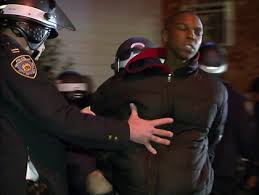 On Monday, US district court judge Shira Scheindlin dealt a serious, but non-lethal blow to the New York City police policy known as “stop-and-frisk.” After weeks of testimony and evidence presented in the case of Floyd v. City of New York, Scheindlin ruled that stop-and-frisk violated individuals’ Fourth Amendment right to privacy and Fourteenth Amendment right to equal protection under the law. She did not, however, call for an end to the policy altogether, instead opting to appoint an independent federal monitor to oversee the program and the implementation of reforms that would bring it in line with the Constitution.
Undoubtedly, this is a huge victory for the activists who have been doing work around the issue of stop-and-frisk for years, and perhaps an even bigger victory for the black and Latino young men whose lives have been disproportionately disrupted by repeated violations of their rights. In her ruling, Scheindlin wrote that “the policy encourages the targeting of young black and Hispanic men based on their prevalence in local crime complaints. This is a form of racial profiling.” The ruling may not put an end to stop-and-frisk in its entirety, but at the very least there was a recognition from the court that for years the city’s police force has engaged in a racist practice that has infringed upon the rights of millions.
The same can’t be said of NYC’s current political leadership. In a press conference yesterday afternoon, Mayor Michael Bloomberg and police commissioner Ray Kelly were visibly dismayed with the ruling. Stop-and-frisk has been a signature crime-fighting tool during the Bloomberg years, one that defines his legacy. Kelly has received praise from high places, in large part because of the work he has done in executing the stop-and-frisk policy. For a judge to rule their “success” unconstitutional surely grates. But their defense of “stop-and-frisk,” despite weak attempts to deny as much, went on to show just how racist it is.
Read More Ending Stop-and-Frisk, Keeping the Racism | The Nation.
Rand Paul: ‘I Don’t Think There Is Any Particular Evidence’ Of Black Voters Being Prevented From Voting
By Ian Millhiser

Official portrait of United States Senator (R-KY). (Photo credit: Wikipedia)
Sen. Rand Paul (R-KY), a tea party senator with a long history of opposition to civil rights laws, told an audience in Louisville, Kentucky on Wednesday that there is no evidence of black voters being excluded from the franchise. According to local NPR host Phillip Bailey, Paul said that he does not believe “there is any particular evidence of polls barring African Americans from voting,” during a speech to the non-partisan Louisville Forum.
If Paul is not aware of the evidence indicating widespread efforts to prevent African Americans from voting, then he must not be looking very hard. During the 2012 election, black and Hispanic voters waited nearly twice as long to cast a ballot as white voters. In Florida, lines of up to six hours led an estimated 201,000 people to become frustrated and leave the polls. These lines existed largely because of a voter suppression bill signed into law by Gov. Rick Scott (R-FL) which reduced early voting hours in the state. After the election, top Republicans admitted that the purpose of cutting early voting was to reduce Democratic turnout. One Republican operative conceded that early voting was cut on the Sunday proceeding Election Day because “that’s a big day when the black churches organize themselves.”
Meanwhile, voter ID laws are rampant in states led by conservatives, despite the fact that these laws cannot be justified by any legitimate purpose. Although their proponents routinely claim that an ID requirement is necessary to prevent voter fraud at the polls, such fraud barely exists. According to one study, just 0.0023 percent of votes are the product of in person voter fraud. Meanwhile, even conservative estimates suggest that 2 to 3 percent of legitimate voters will turn turned away by a voter ID law — and these voters are disproportionately African American.
Posted in News from the Soul Brother
Tagged african american, discrimination, Florida, Rand Paul, Rick Scott, Voter ID laws, voting
1 Comment
Woman who assaulted singer performing Trayvon Martin tribute charged
Posted in News from the Soul Brother
Tagged assault, California, concert, crime, Dinalynn Andrews-Potter, Lester Chambers, Trayvon Martin
Leave a comment
Martin Luther King: the story behind his ‘I have a dream’ speech

Dr. Martin Luther King giving his “I Have a Dream” speech during the March on Washington in Washington, D.C., on 28 August 1963. (Photo credit: Wikipedia)
By Gary Younge
The night before the March on Washington, on 28 August 1963, Martin Luther King asked his aides for advice about the next day’s speech. “Don’t use the lines about ‘I have a dream’, his adviser Wyatt Walker told him. “It’s trite, it’s cliche. You’ve used it too many times already.”
King had indeed employed the refrain several times before. It had featured in an address just a week earlier at a fundraiser in Chicago, and a few months before that at a huge rally in Detroit. As with most of his speeches, both had been well received, but neither had been regarded as momentous.
This speech had to be different. While King was by now a national political figure, relatively few outside the black church and the civil rights movement had heard him give a full address. With all three television networks offering live coverage of the march for jobs and freedom, this would be his oratorical introduction to the nation.
After a wide range of conflicting suggestions from his staff, King left the lobby at the Willard hotel in DC to put the final touches to a speech he hoped would be received, in his words, “like the Gettysburg address”. “I am now going upstairs to my room to counsel with my Lord,” he told them. “I will see you all tomorrow.”
A few floors below King’s suite, Walker made himself available. King would call down and tell him what he wanted to say; Walker would write something he hoped worked, then head up the stairs to present it to King.
“When it came to my speech drafts,” wrote Clarence Jones, who had already penned the first draft, “[King] often acted like an interior designer. I would deliver four strong walls and he would use his God-given abilities to furnish the place so it felt like home.” King finished the outline at about midnight and then wrote a draft in longhand. One of his aides who went to King’s suite that night saw words crossed out three or four times. He thought it looked as though King were writing poetry. King went to sleep at about 4am, giving the text to his aides to print and distribute. The “I have a dream” section was not in it.
A few hours after King went to sleep, the march’s organiser, Bayard Rustin, wandered on to the Washington Mall, where the demonstration would take place later that day, with some of his assistants, to find security personnel and journalists outnumbering demonstrators. Political marches in Washington are now commonplace, but in 1963 attempting to stage a march of this size in that place was unprecedented. The movement had high hopes for a large turnout and originally set a goal of 100,000. From the reservations on coaches and trains alone, they guessed they should be at least close to that figure. But when the morning came, that expectation did little to calm their nerves. Reporters badgered Rustin about the ramifications for both the event and the movement if the crowd turned out to be smaller than anticipated. Rustin, forever theatrical, took a round pocket watch from his trousers and some paper from his jacket. Examining first the paper and then the watch, he turned to the reporters and said: “Everything is right on schedule.” The piece of paper was blank.
via Martin Luther King: the story behind his ‘I have a dream’ speech | World news | The Guardian.
 soulbrotherspeaks.com
What other black politicians can learn from Booker’s victory