
-
Recent Posts
Top Posts & Pages
Categories

Image via CrunchBase
By Andrew Berg
Online retailer Amazon said today that it will create 5,000 new full-time jobs across the United States.
According to a press release, Amazon calims the new positions will pay 30 percent more than traditional retail jobs and include comprehensive benefits beginning on day one, including healthcare, 401(k) and company stock awards. Amazon did not offer specifics on what the jobs would pay.
The company also said that it will pre-pay up to 95 percent of tuition for courses related to in-demand fields, regardless of whether the skills are relevant to a career at Amazon.
Amazon currently employs over 20,000 full-time employees in its U.S. fulfillment centers.
The new jobs are currently available in: Breinigsville, Pa., Middletown, Del., Chattanooga, Tenn., Murfreesboro, Tenn., Charleston, S.C., Patterson, Calif., Chester, Va., Phoenix, Ariz., Coppell, Texas, San Antonio, Texas, Haslet, Texas, San Bernardino, Calif., Hebron, Ky., Spartanburg, S.C., Indianapolis, Ind., Tracy, Calif., Jeffersonville, Ind.
Amazon last week reported that revenues had jumped 22 percent in the second quarter but the company still fell to a $7 million loss.
Shares of Amazon were flat in early trading Monday at $311.
Read More Amazon to Hire 5000 New Employees at Fulfillment Centers.
*** If you live in the areas listed and need a job, GO GET THAT MONEY!!!! Good luck!!! ~ SB***

Emmett Till (Photo credit: Wikipedia)
Beyonce has urged supporters of Trayvon Martin to be inspired by the protests that followed the death of another black teenager, Emmett Till. She is only one of a number of Americans who have drawn a parallel between the two cases – though others point out there are major differences. So who was Till?
After attending an event in New York in memory of teenager Martin, who was shot dead in Florida, the pop singer wrote a message on her website.
“We have made so much progress and cannot allow hatred and racism to divide us,” she wrote. “When we all join together, people of all races, we have the power to change the world we live in. We must fight for Trayvon the same way the generation before us fought for Emmett Till.”
In the summer of 1955, the 14-year-old Till was far from home when his life ended in a most violent way, apparently for whistling at a white woman.
Dragged from his bed at his uncle’s home in a small Mississippi town, he was beaten so badly that his face was unrecognisable when the corpse was recovered from the river three days later. He had been shot in the head and his body tied to a 70lb (32kg) fan.
The two men known locally to have carried out the attack were acquitted of murder. The following year, they admitted responsibility in a magazine interview, but said they had done nothing wrong.
“There was a civil rights movement before Emmett Till came along,” says David Beito, a professor of history at the University of Alabama. “But the outrage galvanised the movement in ways that hadn’t occurred before.”
Till’s mother insisted the coffin remain open so the extent of his injuries could be seen by the thousands of people who paid their respects in Chicago. A weekly magazine, Jet, aimed at African Americans, published gruesome photographs of his beaten face, to show the brutality of the attack.
There were rallies across the country at which Till’s mother, Mamie, spoke to crowds numbering 10-20,000 people.
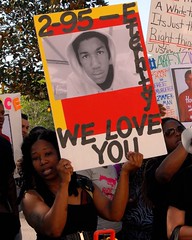
Trayvon Martin Protest – Sanford (Photo credit: werthmedia)
By Jason Whitlock
Here’s what the race baiters on the right fail to comprehend: There’s a clear-cut, easy-to-follow blueprint for avoiding the ravages of black-on-black violence and crime. America has yet to provide us a comparable blueprint for avoiding racial profiling.
That’s why it’s impossible for ordinary, rational black folks to let go of Trayvon Martin and the not-guilty verdict in the George Zimmerman trial.
We know all too well the horrors transpiring in Chicago and other urban areas where the neglected offsprings of America’s prison-institutionalized and prison-values-corrupted engage in a predictable war of hopelessness and self-hatred. The consequences of our drug war and its companion, mass incarceration, do not stop at prison walls.
We know that. We do also, however, know how to escape their wrath.
When my mother caught a burglar climbing through our kitchen window in 1975, she promptly took a second job and moved me and my older brother to an Indianapolis suburb.
Willie Clark, my best childhood friend, grew up in a home just a few blocks from my old neighborhood. You could walk out his family’s backyard and reach a government housing project in less than a minute. The entire area was rough.
Willie’s parents had little trouble keeping him out of trouble. They raised him and his two sisters in the church. They taught him to be respectful and careful of where he went and who he befriended. They supported his athletic endeavors, kept tabs on his academic progress, demanded that he avoid drugs and nurtured a belief he could achieve something in this country.
He was raised in the ‘hood. He graduated from college, opened an American Family Insurance agency, married and built a home in the suburbs for his wife and three kids. He moved up and moved out.
My dad owned small taverns (think ghetto Cheers) in Indianapolis’ inner-city for 35 years. I loved the places, visited them often as a kid and socialized at them as an adult. I never once had any problems.
Navigating the ghetto is difficult. But it’s not remotely impossible. If you’re intent on avoiding trouble, use common sense and choose to interact with all people respectfully, you can, short of bad luck, stay clear of the nonsense. And, if all else fails and you don’t want to walk the tightrope, you can do what my mother did and take the necessary steps to leave the ghetto.
Read More The Real Problem: Race Baiters’ Inability to Think, Comprehend | Jason Whitlock.

Trayvon Martin Rally (by Vic Damoses) (Photo credit: dombrassey)
By Gene Demby
Phillip Agnew was blindsided by the verdict in the George Zimmerman trial. The decision came down late on a Saturday night. Agnew was expecting the neighborhood watchman who killed Trayvon Martin to be found guilty.
Agnew, 28, leads a group of young activists called the Dream Defenders, which formed in Florida last year in the weeks following Trayvon’s shooting death. It was one of the many groups that sprouted up in cities across the country in response to the shooting.
These new organizations relied on social media to amplify their calls for charges to be brought against Zimmerman, who initially was not held for any crime. Thousands of people showed up at marches, while many more signed online petitions or changed their Facebook profile pictures to shots of themselves sporting hoodies like the one Trayvon was wearing when he was killed. It was the latest demonstration of a kind of hashtag activism — think #STOPKONY — in which people used social media to lower the barrier of entry for civic engagement. That was especially true for people who hadn’t previously thought of themselves as activist types.
Because so much of the activism was Internet-based, it was both loud and diffuse. But with the trial over, all the protest energy inspired by the case suddenly lacked a discrete focus or goal. Some groups are trying to redirect the energy of disappointed activists toward changing laws like the ones they say contributed to Trayvon’s shooting. And that means taking on the stand your ground law in Florida and around the country.
It’s hard to imagine a tougher target.
Agnew decided to stage a sit-in at the Florida Capitol building. The goal: to press Gov. Rick Scott to call a special session to consider what the Dream Defenders call Trayvon’s Law. One of its major pillars is repealing Florida’s stand your ground law.
After the killing, Daniel Maree, a New York advertising strategist, started a group called A Million Hoodies. He used Twitter and social media to organize a rally of thousands of people in Manhattan in the spring of last year. He said that activism had been “updated for a social media generation that is more aggressive, more outspoken.”
Read More After Zimmerman Verdict, Activists Face A New, Tougher Fight : Code Switch : NPR.
By Eternity E. Martis
 They say nothing comes without a price. However, in the case of being one of the only coloured girls in my city, nothing comes without a race.
I live in a predominately white city. Not by choice (I’m from Toronto), but to attend university. When I first got to the city, I thought people would be incredibly racist and I’d be excluded and snubbed by my peers. Well, the opposite happened.
Arrogance aside (I promise), everywhere I went, I was white men’s object (emphasis on object) of desire. And it wasn’t just white men — all races of men I’ve never encountered, but white men seemed the most enthralled by my presence. But the initial adoration and my swelled ego soon subsided after I realized that men were not attracted to me for being just a “pretty face” — I was being objectified, exoticized and sexualized for being one of few coloured girls in a sea of white men. I felt alone. And more importantly, I felt disgusted with myself.
Feminist, social activist and African American author bell hooks terms this kind of attraction to the ‘Othered’ body as “Eating the Other.” This is the phenomenon where white men as well as the media view coloured women’s bodies, especially black women’s, as a site of difference. The coloured body is stereotypically everything the white woman’s body is not: she is not “pure,” “fair,”%
Read More Why I Don’t Sleep With White Guys | Eternity E Martis.

2010 MLK Event-Keith Boykin (Photo credit: pennstatenews)
By Keith Boykin
Next week I will participate in a racial discrimination hearing against a Manhattan night club that frisked and searched me when I attended on a “Black night” but does not search patrons on mostly white nights.
Last week, I was accused of stealing an iPhone by a white woman in Miami who came up to me and asked if she could search my pockets to find it. It was not a joke or a pickup line.
And just last month, I had to pull out my own iPhone to photograph and report the license plate and medallion number of a taxicab driver in New York’s Union Square who refused to pick me up and then drove across the street to pick up a white customer seconds later.
For many African-Americans, I suspect these stories aren’t entirely surprising. As President Obama said last week, racism is a daily part of our lives. Like air and water, it’s part of the environment in which we live. Yet far too many white Americans still live in denial about its persistence.
That’s the conclusion to be drawn not just from anecdotal experience but from a new NBC News/Wall Street Journal poll out Wednesday that showed a vast disparity between white and Black perceptions on race relations. The poll, conducted after George Zimmerman was acquitted for shooting unarmed 17-year-old Trayvon Martin, found that 52 percent of whites think race relations are “good” in America while 58 percent of Blacks describe race relations as “bad.”
The new poll numbers follow similar results from a Washington Post-ABC News poll two days earlier. In that poll, 86 percent of Blacks disapproved of the Zimmerman verdict while only 31 percent of whites felt that way. Even more disappointing is that 86 percent of African-Americans say Blacks and other minorities do not get equal treatment under the law, while only 41 percent of whites think that’s true.
So what explains the disconnect?
Years ago, I heard a law professor explain what I call the “magnet analogy.” Remember those big red and silver horseshoe magnets from high school? Now imagine you had to walk around the world with a huge horseshoe magnet on your neck. Aside from the heavy burden of carrying the extra weight, you’d quickly see the world a lot differently from those without the magnet.
Read More Commentary: Why White People Don’t See Racism | News | BET.

Trayvon Martin Protest – Sanford (Photo credit: werthmedia)
By Harry J. Enten
Why vote? It’s a question often asked. Even for an election junkie, it can sometimes be difficult to know if it will really make a policy difference if we vote. Yet, the George Zimmerman trial and its aftermath offers a prime example of why voting is important. Here’s why.
A Pew Research poll released after the verdict showed that a slight plurality of those surveyed were dissatisfied with the verdict: 42% said they were not happy, while 39% said that they were satisfied. But the racial and age gaps between the two camps were wide.
Whites were in favor of the ruling by a 19pt margin. Blacks against it by an 81pt margin. Latinos were dissatisfied by a 33pt margin. To age: 18-29 year-olds were unhappy by a 25pt margin; 30-49 year-olds by a 11pt margin; 50-64 year-olds were happy by a 1pt margin; while 65+ year-olds approved by a 17pt margin. The general age pattern holds even when controlling for the fact that minorities tend to make a larger percentage of younger voters.
As Nate Cohn points out, these differences look pretty much identical to the coalitions in the 2012 presidential elections.
Any of the changes are within the margin of error. But there is one key difference between the two. The presidential election rundown was among likely voters, while the Zimmerman data are among all adults. While the latter gives us a more accurate picture of how all Americans feel, the former enables a better idea of the possible political ramifications. After all, voters are the people politicians listen to.
When Pew concentrated solely on registered voters, they found that the 3pt margin between satisfied and dissatisfied flipped: 43% were satisfied, while 40% were unsatisfied. Those who are not registered to vote were against the verdict by a 19pt margin. The reason for this is that Latinos and 18-29 year-olds of all races and ethnicities are far less likely to vote. This was mirrored in the 2012 presidential election, when polls of all adults gave Obama a far wider lead among those who did not vote.
 soulbrotherspeaks.com
Race-blind admissions: White privilege is too often ignored in movies and in life
By Ann Hornaday
It’s New Year’s Eve in San Francisco. On a crowded street, while waiting for his date to go to the bathroom, Oscar strikes up a conversation with a white man around his age, who, like Oscar, has committed a crime. Unlike Oscar, he has clearly rebounded. After they chat about the women in their lives, the stranger confesses that he was so broke when he married his wife that he had to steal her ring. He issues a warning about going down the same road, then cheerfully tells Oscar that he now owns a business and gives him his card.
That brief but eloquent scene deftly illustrates the subtleties of white privilege — a reality too seldom portrayed in film and too often ignored by its beneficiaries in life.
When Hollywood tackles race directly, it’s usually by way of uplifting allegories like “Guess Who’s Coming to Dinner,” “Crash” and “The Help,” each of which, in its own way, perpetuates the consoling idea that eradicating racism is simply a matter of purging our negative prejudices.
Rarely do films ask audiences to grapple with the deeply embedded, race-based habits that give white Americans an edge in everything from housing to employment, or the positive racial profiling that grants white people countless free passes.
Indeed, far from being confronted with the pernicious legacies of official discrimination, white audiences tend to have their assumptions about race reinforced. Black people are far more likely to go see movies with majority-white casts than vice versa. And whereas movies about African Americans have tended to be confined to comedies and urban dramas, the white experience has long been represented across a diverse range of genres, stories and characters.
Read More Race-blind admissions: White privilege is too often ignored in movies and in life – The Washington Post.