By Roz Edward

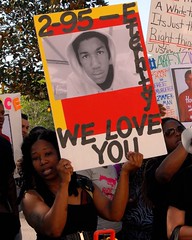
Trayvon Martin Protest – Sanford (Photo credit: werthmedia)
The history of America is still being written and the acquittal of George Zimmerman of second degree murder by a Florida jury of five White women and one Hispanic female in the mindless shooting death of 17-year-old African American teenager Trayvon Martin is now an important chapter in that history that gave birth to centuries of slavery and Jim Crow.
Like so many, I was shocked by the verdict and could not comprehend how in 2013, a jury purporting to be part of balancing the scales of justice would let go a martial arts trained man with a gun who got out of his car, soaked in his prejudice and tired of seeing Black youths in the neighborhood, followd an innocent teenager and killed him. The prejudiced jury, as evidenced by the interview juror B-37 gave to CNN Monday night, revealed the dark character of a system of justice that has long been failing young Black boys. How long will this continue before those who administer justice finally right the wrongs of the criminal justice system?
Even though juror B-37 admitted that Zimmerman went too far and should not have gotten out of his car with his gun and followed Trayvon, she still believed “George,” as she referred to Zimmerman repeatedly, was on the right side of the law. Then she said both Trayvon and Zimmerman were responsible for what happened, but she assigned no culpability to Zimmerman. More troubling for the juror was when she described Trayvon’s female friend, Rachel Jeantel, as not “credible” because of her “communication skills,” and that she was “using phrases I never heard before,” showing the deep-seated prejudice of a jury whose life experiences do not equate to Trayvon, his female friend or any other Black person.
Apparently, by referring to a Black witness as not credible and using phrases she claimed she does not understand, juror B-37 confirmed to us that the jury members have had limited or no dealings whatsoever with the Black experience.
They have no inkling of the life of a Black teenager and sought to compare the behavior of 17-year-old Trayvon to that of a grown man like Zimmerman.
Makes us wonder why the prosecutors would, in the first place, if they were really interested in winning this case and given the national attention it received, allow a jury that is not diverse in thought, belief systems and life experiences to examine one of the most important racial justice cases in history.
Did the prosecutors conclude that Trayvon’s life was not worth vigorously fighting to convict his killer by throwing the entire book, including racial animus, at Zimmerman? Did the prosecutors decide because of national attention they would just charge Zimmernan for the sake of charging but not put up a strategic and strong fight since their own Sanford Police Department showed no value in a dead Black boy’s life by letting his killer talk his way out of an arrest and go home to sleep on the night he killed Trayvon Martin?
Read More Jim Crow Justice: Trayvon Martin and the generational burden of Black boys.

 Comic-Con was THE PLACE to premiere this trailer! Arriving on “Black Friday” Thanksgiving weekend 2013 is the 2nd installment of Suzanne Collins’ trilogy; The Hunger Games: Catching Fire. The cast returns from the original led by new Academy Award winner Jennifer Lawrence and adds fellow award winner Philip Seymour Hoffman, Jeffrey Wright, and Amanda Plummer to the mix.


 soulbrotherspeaks.com
It Is Time to Come Out of the Closet About Racism in America
Community March Against Racism (Photo credit: Caelie_Frampton)
By Michele Hunt
The Trayvon Martin tragic injustice has sparked a long overdue conversation in America. What is at the heart of racism in our country? Why is the fear so intense between the black and white communities? Why can’t we find the courage to authentically talk about it?
I am so proud of our president for calling on us to engage in thoughtful conversations in our homes, churches and communities across the nation. He is asking us to talk about why an innocent young black male has to fear for his life walking home, why he becomes a suspect when he enters a store, or feared when he steps into an elevator — normal activates most of us take for granted. He is also asking us to go deeper, to get to the heart of the matter. I was very happy to hear the president talk about the need to understand the “context”; the background and circumstances that got us to this horrible place. Context matters, it gives us the framework to begin to understand. We cannot begin to heal and grow without first understanding the problem. We cannot understand one another until we share our stories.
I don’t believe in the saying “Familiarity Breeds Contempt”; I believe familiarity breeds understanding. Remember Aesop’s fable The Fox and the Lion:
People started to understand same-sex love when their son, their daughter, a family member or a friend, came out of the closet and told their story. Many people’s first reaction was fear, which translated into hate, prejudice and sometimes abuse. The more people came out and shared their stories, the less people feared and judged; that put us on a path to collective understanding. That understanding grew to a critical mass resulting in the transformation of our social acceptance of people who love someone of the same sex. Laws across our country (and the world) are beginning to bring justice to people who are a part of the LBGT community and their families.
Most of us can relate to women’s rights because we were all birthed by women and many of us have sisters, grandmothers, nieces and female friends. Even with this intimate familiarity, our society did not progress on women rights until women came out of the closet of what Betty Friedan called The Feminine Mystique. When women found the courage to tell the truth about their lives and share their hopes and dreams, society began to liberate women and girls.
Read More It Is Time to Come Out of the Closet About Racism in America | Michele Hunt.