
Coming March 7, 2014…
-
Recent Posts
Top Posts & Pages
Categories
Coming March 7, 2014…
By Decca Aitkenhead
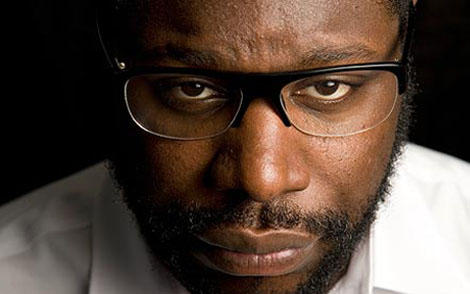 Steve McQueen has known about slavery for as long as he can remember. To the son of West Indian parents, slavery’s history is the story of his very existence: “So there is a weight on your chest, on your back, from a very early age. ” Yet he cannot recall having ever felt angry about it.
“Angry?” He looks puzzled. “No. You feel hurt that someone did such things, but angry? No.” To McQueen, the notion sounds as bizarre as finding slavery funny. “Painful, sure. Hurt, absolutely. I don’t know if that can be seen as anger. Not to say that I’m not angry with injustice, of course – and slavery is a huge injustice. But thinking about it that way? No.” From his baffled expression, you might think him literally unaware that anger is quite a common response.
Like many artists, McQueen experiences the world from a highly singular perspective. As a working-class boy growing up in 1980s suburbia, “there were no examples of artists who were like me. When did you ever see a black man doing what I wanted to do?” His father kept telling him to get a trade; even when his son began to be successful, “he was still taking the piss, saying to my friend, ‘Do you understand what Steve does?'” McQueen’s first film, Bear, was 10 minutes long, silent, and consisted of two naked men, one of them him, wordlessly circling each other, staring and sparring.
He has never been interested in pleasing mainstream tastes, but no matter how uncompromising his work, it keeps becoming more and more popular. After winning the 1999 Turner prize with a video installation filmed from an old oil drum rolling through Manhattan, he was awarded an OBE, followed in 2011 by a CBE. His first feature film, Hunger, released in 2008, was a remorselessly gruelling portrayal of Bobby Sands starving himself to death in the Maze prison, and not an easy sell, but the critics went wild and McQueen won a Bafta. Shame, his second movie, could not have been a less sexy study of sex addiction, but took more than £10m at the box office. The director shot his latest movie in just 35 days, with one camera and a budget of barely £10m, and wasn’t even confident of finding a distributor brave enough to take it. This week 12 Years A Slave opens in Britain, having already earned $40m (£25m) in US ticket sales, multiple Golden Globe nominations and countless predictions of an Academy Award that would make McQueen the first black feature film director to win an Oscar.
Read More Steve McQueen: my hidden shame | Film | The Guardian.
Sasheer Zamata’s first appearance as a featured performer on SNL.
By Alex Sherman and Aaron Kirchfeld
 SoftBank Corp., which is seeking to combine its Sprint Corp. (S) unit with T-Mobile US Inc., has entered direct talks with T-Mobile’s owner Deutsche Telekom AG (DTE) to resolve obstacles to a potential deal, people with knowledge of the matter said.
While SoftBank has assurances from banks that financing for a deal will be available, an agreement could still take months to reach, one of the people said, asking not to be identified as the information is private. Unresolved issues include how much cash and stock SoftBank will pay for Deutsche Telekom’s 67 percent (TMUS) stake in T-Mobile, and how Sprint and T-Mobile will be integrated, two people said.
 Deutsche Telekom wants an all-cash offer for T-Mobile, which has a market value of about $26 billion, and SoftBank is trying to finance a deal to provide as much cash as possible, one of the people said. SoftBank founder and president Masayoshi Son is seeking to borrow about $20 billion from banks including Goldman Sachs Group Inc., Mizuho Bank Ltd. and Credit Suisse Group AG, people said last month. Sprint would take on any debt relating to the deal, one person said.
Combining Sprint and T-Mobile would give each company a better chance of long-term success against AT&T Inc. and Verizon Communications Inc. Sprint’s management isn’t controlling deal talks and knows Son will make the decision on whether or not to push ahead with a deal, another person said. Sprint Chief Executive Officer Dan Hesse knew Son wanted to acquire T-Mobile when he agreed to sell SoftBank the majority of the company, the person said.
Read More SoftBank Said to Enter Direct Talks on Sprint-T-Mobile Deal – Bloomberg.
By Steven Musil
 The National Security Agency is using secret wireless technology that allows it to access and alter data on computers, even when they are not connected to the Internet, according to a New York Times report.
Since 2008, the agency has been increasingly using a “covert channel of radio waves” that can transmit from hardware installed in the computers, according to NSA documents and experts interviewed by the Times. Signals can then be sent to briefcase-size relay stations miles away, according to the report.
The NSA has also installed surveillance software on nearly 100,000 computers around the world, according to the Times. The newspaper said the Chinese Army was a frequent target of such technology but said there was no evidence that the agency used either technology inside the US.
Repeating earlier denials that its data collection activities are arbitrary or unconstrained, the NSA rejected any comparison to Chinese attackers who have been accused to planting similar software on computers belonging to US companies and government agencies.
“NSA’s activities are focused and specifically deployed against — and only against — valid foreign intelligence targets in response to intelligence requirements,” the NSA said in a statement. “In addition, we do not use foreign intelligence capabilities to steal the trade secrets of foreign companies on behalf of — or give intelligence we collect to — U.S. companies to enhance their international competitiveness or increase their bottom line.”
Read More NSA reportedly using radio waves to tap offline computers | Politics and Law – CNET News.
By Annie-Rose Strasser
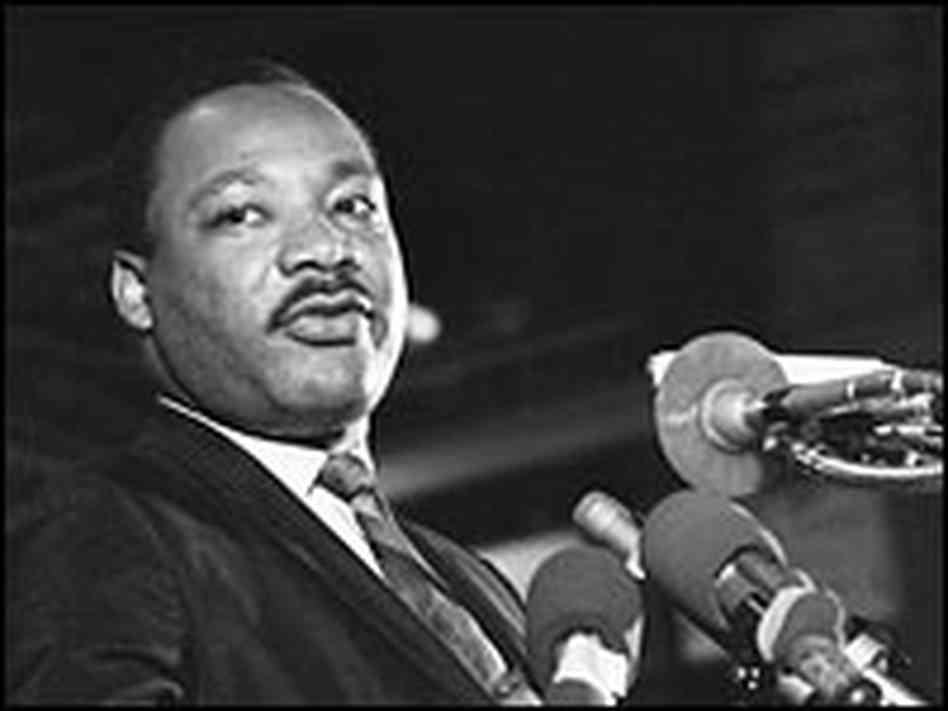 Rather than simply celebrating the accomplishments of his life on Martin Luther King, Jr. day, this year ThinkProgress wants to take a look back at the unfinished parts of King’s legacy. While the civil rights leader changed the conversation around race and justice in the U.S., many of his goals never came to fruition.
Here’s a look at four of the things King demanded but never saw completed:
1. A living wage. One of the demands protesters listed for the March on Washington was a minimum wage. “Anything less than $2.00 an hour,” King and his compatriots argued, fails to “give all Americans a decent standard of living.” In 2014 dollars, a $2 an hour wage would work out to about $15.27. But minimum wage is actually much, much lower — less than half of that — today. Forty-two percent of those earning minimum wage are people of color.
2. Desegregation. King hoped to see the end not just of legal segregation in the South, but also of the de facto segregation that existed in Northern businesses, housing, and schools. He even toured Chicago advocating for the end of this kind of segregation, saying civil rights leaders needed to “eradicate a vicious system which seeks to further colonize thousands of Negroes within a slum environment.’’ But today, public schools are more segregated than they were 40 years ago. The unemployment rate for black Americans has remained above 10 percent for most of the last half a century, and black workers earn on average $22,000 less a year than their white counterparts. Black homebuyers are shown significantly fewer homes than their white counterparts when shopping for a house. Ethnic identity is still the key factor in where people reside.
3. Fair voting. King campaigned extensively for legislation like the Voting Rights Act. And he lived to see it passed. But legislators, largely Republicans, have been working to roll back the rights protected under the VRA since its inception. Those efforts have become even more acute recently. More than half the states introduced restrictive voting legislation in 2013 alone, according to a review by the Brennan Center, at a total of 92 separate bills in 33 states. The Supreme Court also struck down a major portion of the Voting Rights Act in 2013, allowing states previously subject to the VRA to put voting laws on the books without federal oversight. Now a group of members of congress — including Rep. John Conyers (D-MI), who incidentally established the first official Martin Luther King Day — is working to undo the damage of that decision.
Read More Why Martin Luther King’s Dream Is Still Unfulfilled | ThinkProgress.
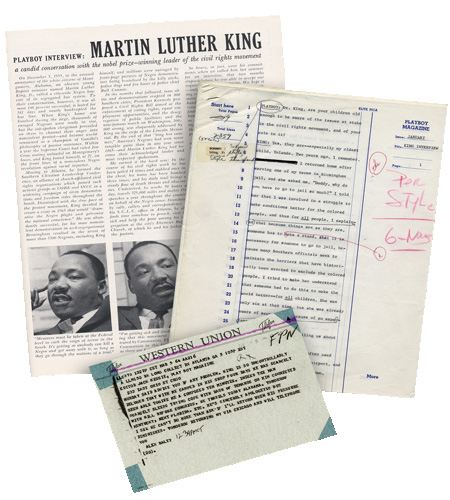
(photo credit: Duke University)
In January 1965, Playboy published Alex Haley’s interview with the Reverend Martin Luther King Jr., shortly after King received the Nobel Peace Prize. In those days, the magazine still wasn’t identifying the interviewer by name, so Haley reported anonymously:
“So heavy were Martin Luther King Jr.’s commitments when we called him last summer for an interview that two months elapsed before he was able to accept our request for an appointment. We kept it—only to spend a week in Atlanta waiting in vain for him to find a moment for more than an apology and a hurried handshake… King was finally able to sandwich in a series of hour and half-hour conversations with us among the other demands of a grueling week. The resultant interview is the longest he has ever granted to any publication.
“Though he spoke with heartfelt and often eloquent sincerity, his tone was one of businesslike detachment. And his mood, except for one or two flickering smiles of irony, was gravely serious.”
Haley: As one who grew up in the economically comfortable, socially insulated environment of a middle-income home in Atlanta, can you recall when it was that you yourself first became painfully and personally aware of racial prejudice?
King: Very clearly. When I was 14, I had traveled from Atlanta to Dublin, Georgia, with a dear teacher of mine, Mrs. Bradley; she’s dead now. I had participated there in an oratorical contest sponsored by the Negro Elks. It turned out to be a memorable day, for I had succeeded in winning the contest. My subject, I recall, ironically enough, was “The Negro and the Constitution.” Anyway, that night, Mrs. Bradley and I were on a bus returning to Atlanta, and at a small town along the way, some white passengers boarded the bus, and the white driver ordered us to get up and give the whites our seats. We didn’t move quickly enough to suit him, so he began cursing us, calling us “black sons of bitches.” I intended to stay right in that seat, but Mrs. Bradley finally urged me up, saying we had to obey the law. And so we stood up in the aisle for the 90 miles to Atlanta. That night will never leave my memory. It was the angriest I have ever been in my life.
Read More Alex Haley’s 1965 Playboy Interview with Rev. Martin Luther King Jr. – The Daily Beast.
By Josh Eidelson
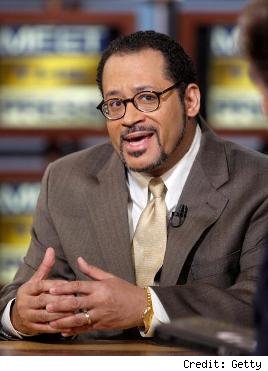 “In the last thirty years we have trapped King in romantic images or frozen his legacy in worship,” Michael Eric Dyson wrote in his 2000 book “I May Not Get There with You: The True Martin Luther King, Jr.” Since King’s 1968 assassination, Dyson argued, America has “sanitized his ideas”; “twisted his identity”; and “ceded control of his image to a range of factions …”
Fourteen years later, Martin Luther King remains sainted and distorted in American culture and politics. In an interview with Salon, Dyson revisited that argument, and offered criticism for Glenn Beck, Bill Cosby and Barack Obama. “We’ve deliberately dismembered him through manipulation of his memory,” said Dyson, a Georgetown professor and MSNBC commentator. A condensed version of our conversation follows.
You wrote, “We have surrendered to romantic images of King at the Lincoln Memorial inspiring America to reach for a better future,” while “we forget his poignant warning against gradual racial progress and his remarkable threat of revolution should our nation fail to keep its promises.” How did that forgetting happen?
Well, I think there’s a kind of a deliberate dis-memory on the parts of those who are most challenged by King’s vision, and the demands of his dreams — not the rhetoric that flows so easily from that mountaintop of holy sacrifice and that sunlit summit of expectations that he expressed in 1963. The rigorous demand for social justice that he articulated once he descended from that mountaintop experience, and revisited the valley where horrible crimes against black humanity were being committed. Where little girls were being blown to smithereens in church bombings. Where black people continued to be lynched in the Delta and murdered along the highways and byways of American culture.
So Martin Luther King Jr. was an inconvenient hero and icon for those who sought to distance themselves from his troublemaking and his controversy. So now they’ve converted his sharp challenge to American society, and co-opted his radical vision into a kind of namby-pamby “We are the World” universalism that bypasses a challenge to their particular ideas.
On the other hand, you know, there are those who are his fellow-travelers, but who have helped merchandize and package and produce an image of King that is one of a toothless tiger. But in the last three years of his life, he began to talk about the triplets of racism and classism and militarism. He challenged himself and others around him, and those committed to the movement, to take things up even higher, to knock them up a notch or two … and he began to speak about the near-ubiquity of racial hostility, and the racism that was nearly endemic to American society. He said that he was sad to announce that most Americans were unconscious racists.
By Igor Volsky

MLK Memorial (Photo credit: Lane 4 Imaging)
Every January, Martin Luther King, Jr. is universally honored as a national hero who preached a peaceful fight against racial injustice. This saintly image is quite a departure from the kind of attacks the reverend endured over his lifetime. FBI Director J. Edgar Hoover famously called King “the most dangerous Negro” and “the most notorious liar in the country” while keeping him under close surveillance. Over the years, Dr. King’s more controversial edges have been smoothed over, burying his more radical teachings.
1. He pushed for a government-guaranteed right to a job. In the years before his assassination, King re-shifted his focus on economic justice in northern cities as well as the South. He launched the Poor People’s Campaign and put forth an economic and social bill of rights that espoused “a national responsibility to provide work for all.” King advocated for a jobs guarantee, which would require the government to provide jobs to anyone who could not find one and end unemployment. The bill of rights also included “the right of every citizen to a minimum income” and “the right to an adequate education.”
2. He was a critic of capitalism and materialism. King was a strident critic of capitalism and materialistic society, and urged Americans to “move toward a democratic socialism.” Referring to the now iconic Greensboro Lunch Counter sit-ins, he asked, “What good is having the right to sit at a lunch counter if you can’t afford to buy a hamburger?”
King also explicitly linked the problem of capitalism with the problem of racism. “When machines and computers, profit motives and property rights are considered more important than people, the giant triplets of racism, materialism and militarism are incapable of being conquered,” he argued in a speech at Riverside Church in 1967. The reverend was very aware that this kind of challenge was even more dangerous than his work on segregation and civil rights. “You can’t talk about solving the economic problem of the Negro without talking about billions of dollars. You can’t talk about ending the slums without first saying profit must be taken out of slums,” he warned his staff in 1966. “You’re really tampering and getting on dangerous ground because you are messing with folk then. You are messing with captains of industry. Now this means that we are treading in difficult water, because it really means that we are saying that something is wrong with capitalism.”
Read More 4 Ways Martin Luther King Was More Radical Than You Thought | ThinkProgress.
By Malcolm Jones
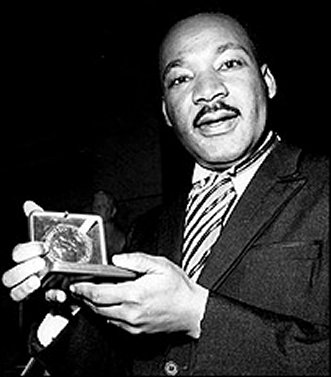
(photo credit: http://www.drmartinlutherkingjr.com)
Martin Luther King’s gifts were manifest. He was an inspired leader, a galvanizing orator, and a brilliant polemicist and prose writer. But more than anything, he knew how to rise to an occasion.
On December 10, 1964, when he received the Nobel Peace Prize, he knew the world was watching. He knew that he was the public face of the American civil rights movement, and that everything he said would be weighed and judged, sometimes harshly. Put in that position, almost any of us would tremble. But King just stepped up to the podium and delivered one of the finest speeches of his life.
“I accept the Nobel Prize for Peace at a moment when 22 million Negroes of the United States of America are engaged in a creative battle to end the long night of racial injustice,” he began. “I accept this award on behalf of a civil rights movement, which is moving with determination and a majestic scorn for risk and danger to establish a reign of freedom and a rule of justice. I am mindful that only yesterday in Birmingham, Alabama, our children, crying out for brotherhood, were answered with fire hoses, snarling dogs and even death. I am mindful that only yesterday in Philadelphia, Mississippi, young people seeking to secure the right to vote were brutalized and murdered. And only yesterday more than 40 houses of worship in the State of Mississippi alone were bombed or burned because they offered a sanctuary to those who would not accept segregation. I am mindful that debilitating and grinding poverty afflicts my people and chains them to the lowest rung of the economic ladder.”
King was already famous as an orator, having delivered his “I Have a Dream” speech before hundreds of thousands of people a year earlier (though hindsight has elevated that speech to a level of recognition that it did not receive in many news accounts of the 1963 March on Washington—the Washington Post story, for example, ignored it almost completely, mentioning only one line in the next day’s coverage). In the space of a few weeks, and forever thereafter, King was known almost exclusively for the “Dream” speech.
That speech, as good as it was, was also typical. As an American orator, King had no rivals in his lifetime. He delivered rousing speeches time and again, to memorable effect. And people came to expect it, which may explain why the Nobel speech unfortunately gets less attention.
If you watch a tape of the proceedings, you will be struck by the speaker’s somber reserve. There are no verbal crescendos; there is very little emotion and no drama at all. The template for most of King’s speeches was the sermon, but this is not a sermon. Quiet and reflective, it is more like a prayer.
Was he nervous? Surely he was. But he had faced tougher crowds than the Nobel audience. No, I think his muted delivery was deliberate. I think he wanted to draw people’s attention away from himself and put it on the substance of his text. But as a result, the address is almost too quiet. Because it is not the rousing King we expect, we are disappointed.
Read More Martin Luther King’s Nobel Speech Is an Often Ignored Masterpiece – The Daily Beast.
 soulbrotherspeaks.com