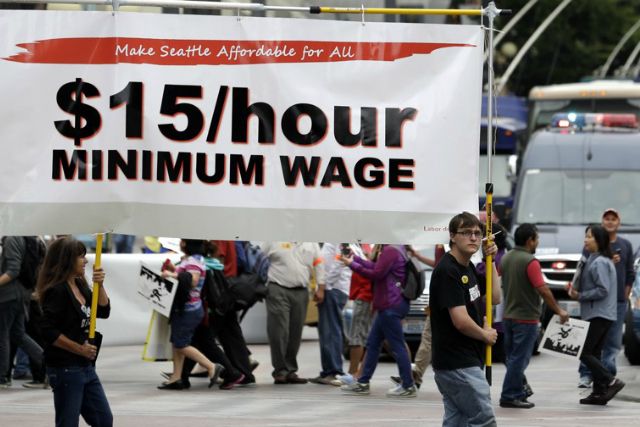
Income Inequality in 2014

By Lincoln Mitchell

Wall Street Protests Fort LauderdaleBy the end of 2013, it appeared that the major domestic political story of the year had been the botched rollout and negative reaction, in some quarters, to the Affordable Care Act (ACA). It is likely, however, that a year from now the ACA will be more accepted as a real, but limited, improvement to health care policy in the US and that another issue will have emerged as the most important issue of 2013.

2013 was the year where issues of income inequality, raised by the Occupy Movement in 2011, stressed by Pope Francis and, belatedly, by President Obama finally came to the fore of American politics. It is likely they will remain there for some time to come. Income inequality is not new in American politics, but the attention it received in 2013 was. While President Obama\’s recent speech on the topic is unlikely to lead to significant efforts to address income inequality, it demonstrates that the issue is firmly in the mainstream, for now.

Income inequality is different from poverty, an issue that is often discussed by politicians. These discussions, until this year, tended to frame poverty as an isolated issue growing out of individual or collective failings. Income inequality is different because it suggests that the problem is structural and deeply embedded in our larger economic system.

Accordingly, income inequality is considerably more controversial and divisive than poverty. Almost everybody can agree that poverty is a problem and that we would be better off, both nationally and globally, if there was less of it. There are heated disagreements about the best ways to address the problem, with some calling for more state intervention and others calling for letting the market ameliorate problems of poverty, but most recognize the problem itself.

Read More Income Inequality in 2014 | Lincoln Mitchell.

Posted in News from the Soul Brother | Tagged , , , , , , , , | Leave a comment

African Americans and Technology Use

cyber_securityBy Aaron Smith

This report on African Americans and technology is the first in a series of demographic snapshots of technology use and adoption among different groups of adults in the United States. Based on a survey of 6,010 American adults, including 664 who identify as African American, it offers a detailed look at a number of key subgroups within the black population such as: men vs. women, old vs. young, low income vs. high income, and parents vs. non-parents.

The black/white “digital divide” continues to persist, but is not consistent across technology platforms or demographic groups

African Americans have long been less likely than whites to use the internet and to have high speed broadband access at home, and that continues to be the case. Today, African Americans trail whites by seven percentage points when it comes to overall internet use (87% of whites and 80% of blacks are internet users), and by twelve percentage points when it comes to home broadband adoption (74% of whites and 62% of blacks have some sort of broadband connection at home). At the same time, blacks and whites are on more equal footing when it comes to other types of access, especially on mobile platforms.

In addition, the gap between whites and blacks when it comes to traditional measures of internet and broadband adoption is more pronounced among certain demographic subgroups than among others. Specifically, older African Americans, as well as those who have not attended college, are significantly less likely to go online or to have broadband service at home compared to whites with a similar demographic profile. African Americans age 65 and older have especially low adoption rates compared with whites. Just 45% of black seniors are internet users, and 30% have broadband at home (among white seniors, 63% go online and 51% are broadband adopters).

On the other hand, young, college-educated, and higher-income African Americans are just as likely as their white counterparts to use the internet and to have broadband service at home. Some 86% of African Americans ages 18-29 are home broadband adopters, as are 88% of black college graduates and 91% of African Americans with an annual household income of $75,000 or more per year. These figures are all well above the national average for broadband adoption, and are identical to whites of similar ages, incomes, and education levels.

Read More A demographic snapshot | Pew Internet & American Life Project.

Posted in News from the Soul Brother | Tagged , , , , | Leave a comment

Twelve Tips All Educators Must Know About Educating African American and Latino Students

By Quassan Castro

schoolbooksIn order to achieve success in the classroom with African American and Latino students, the educator must understand the population that he/she teaches, as well as consistently analyze if his/her teaching practices are effective. If you do not understand the population of students you teach, your success in the classroom can be greatly minimized.

With all the recent debates on ways to reach the African American and Latino student population, here is a list of twelve tips all educators of African American and Latino children should know. Some of the tips can apply to all students.

Check Stereotypes

Check any stereotypes you might have at the door. Limiting views can result in limiting expectations of the African American and Latino student. Limiting expectations can result in limited performance. If you believe in the stereotype of the loud mouth Latina, or the bad boy thug, you’re doomed. Do not make false assumptions about your student population, especially if they are contrived from negative stereotypes. If you view the urban school environments as a “mad” house then guess how you directly or indirectly view your students?

Connect with Parents

Establish a positive connection with parents from the first day of class. A phone call to report good news is as equally vital to the success of your student as informing parents when children are struggling.

Read More Twelve Tips All Educators Must Know About Educating African American and Latino Students | Quassan Castro.

Posted in News from the Soul Brother | Tagged , , , , , , , , | Leave a comment

Tony Porter – A Call to Men

Posted in Soul Brother Presents | Tagged , , , , , , | Leave a comment

Disrupted Lives

By Elizabeth Gudrais

imagesCAR0LMWBThe sheriffs announced their arrival with a loud knock. If nobody was inside, they’d have to kick the door in—but at this house, someone was home.

The second-floor apartment was home to Danielle Shaw and her partner, Jerry Allen. On this Wednesday morning in August, Shaw and Allen were at home with young relatives, the children enjoying the last days of summer break.

Then the eviction squad arrived: two Milwaukee County deputy sheriffs and five movers, assigned to get the tenants out as quickly as possible. They were accompanied by Matthew Desmond, assistant professor of sociology and of social studies, who studies poverty, housing, and eviction as a force in the lives of the poor.

As Desmond looked on, the deputies swept into the apartment and briskly outlined the process. The couple could choose to put their belongings in storage at the moving company’s warehouse—and pay a fee to retrieve them—or the movers would leave everything on the curb.

The eviction did not come as a surprise—Shaw and Allen had begun packing, and the living room was already piled high with boxes—but the timing did. Allen protested that upon receiving the eviction notice, he had called the landlord, who said they would have 8 to 10 days before actually having to leave; this was only day six. The deputies explained that once an eviction order is issued, it can be enforced immediately; any delay is due to a backlog of cases.

Read More Harvard sociologist Matthew Desmond on evictions | Harvard Magazine Jan-Feb 2014.

Posted in News from the Soul Brother | Tagged , , , , , | Leave a comment

As Nation Enters Deep Freeze, Congress Is Making Sure Poor Americans Stay Cold

By Alissa Scheller

Large sections of the United States are being frozen by the grip of winter, with a weather system known as a polar vortex bringing subzero temperatures and blizzard conditions across the Midwest. With temperatures set to reach as low as 50 or 60 degrees below zero in some parts of the nation, staying warm will be harder than ever for many Americans. And Congress has only made this task more challenging for those most in need.

Sequestration’s budget cuts last year meant that thousands of families were left in the cold this winter. Congress cut funding for the Low Income Home Energy Assistance Program by about $155 million, and total funding has decreased from $5.1 billion to $3.32 billion since 2010.

HeatingAid_0


Read More As Nation Enters Deep Freeze, Congress Is Making Sure Poor Americans Stay Cold.

Posted in News from the Soul Brother | Tagged , , , , , , , , , | Leave a comment

Seattle’s first socialist council member sworn in

By Associated Press

(photo credit: Washington Times)

(photo credit: Washington Times)

A former community college professor who won a surprising victory in a citywide election was sworn in on Monday as the first socialist city council member in Seattle’s modern history.

Kshama Sawant of the Socialist Alternative party took her oath and served in her first hearing, then gave a speech to throngs of supporters in a ceremonial swearing-in at a packed City Hall.

“I will do my utmost to represent the disenfranchised and the excluded, the poor and the oppressed, by fighting for a $15-an-hour minimum wage, affordable housing, and taxing the super rich for a massive expansion of public transit and education,” said Sawant, 41.

Even in this liberal city, Sawant’s win surprised many. The incumbent, Richard Conlin, was backed by the political establishment. But bolstered by a grass-roots campaign that focused on economic inequality, Sawant beat Conlin, who had served for 16 years.

Read More Seattle’s first socialist council member sworn in | World news | theguardian.com.

Posted in News from the Soul Brother | Tagged , , , , , , , | Leave a comment

How Our Economy Lost $400 Million in One Week Alone

By George Zornick

Long-term unemployment benefits expired on December 28, meaning an absence of checks this week for more than 1 million jobless Americans. That’s bad news for them, of course—but also the rest of us. According to a new analysis from the minority staff of the House Ways and Means Committee released Friday, $400 million was drained from state economies this week alone thanks to the lapse.

Unemployment benefits are one of the more effective forms of stimulus because the money is badly needed and thus spent right away. The Congressional Budget Office says 200,000 jobs will be lost this year if the benefits are not restored, and this week the damage began.

Big states were obviously the hardest hit, naturally: nearly $65 million came out of the California economy in one week alone, according to the analysis. And of course, states represented by Republicans who oppose the extension each suffered some economic harm. Senator John Cornyn twice blocked a vote on an unemployment insurance extension before the holiday recess, and his home state of Texas lost $21.8 million this week.

Yet Republicans, so far, have not expressed any desire to extend the benefits. “Every week that Republicans fail to act tens of thousands of additional long-term unemployed Americans lose this vital lifeline as they look to get back on their feet after the worst recession in generations, and the economy in each state is taking a hit,” said Representative Sander Levin, the ranking member on Ways and Means.

Read More  How Our Economy Lost $400 Million in One Week Alone | The Nation.

Posted in News from the Soul Brother | Tagged , , , , , , , , | Leave a comment

Journey

1011891_660917290589945_154055871_n

Posted in Soul Brother Presents | Tagged , , , , , | Leave a comment

Descendants of ’12 Years a Slave’ subject, Solomon Northup, release video

Posted in News from the Soul Brother | Tagged , , , , , | Leave a comment