
The Deep South Is the Latest Epicenter of the HIV Epidemic

By Zoe Carpenter

imagesMiami. Baton Rouge. Jacksonville. Columbia, South Carolina: these are not the places that immediately come to mind when considering America’s HIV epidemic. But in the ranking of US cities with the highest HIV rates, they are numbers one, two, three and six, respectively.

On Thursday The New York Times ran an important story by Donald McNeil Jr. about the “new face” of HIV— young, poor black and Hispanic men who have sex with men. One thing not mentioned in the article—which focuses on New York City—is the geography of the epidemic, which is now concentrated and most deadly in the Southern states. While only 37 percent of Americans live in the South, half of new HIV infections originate there. Eight of the ten states with the highest rate of infection are in the South, as are nine of the ten states with the highest AIDS fatalities rates.

McNeil focuses mostly on the scarcity of resources available to fund targeted messaging in black and Hispanic communities, and that’s certainly a problem. But the regional dynamics of HIV, and the fact that young men of color who have sex with men actually engage in less high-risk behavior than their white cohorts suggest that messaging isn’t the only thing needed. McNeil’s conclusion is that when it comes the spread of HIV among young men of color, “the prospects for change look grim” because “the national response is fragmented and hesitant.”

There are two policies on the table that could have a profound effect on the rate of new infections in the United States, which has hovered near 50,000 new cases a year for a decade: the expansion of Medicaid, and comprehensive immigration reform. The implications of these policies for HIV are magnified by the fact that their impact would be particularly strong in the South.

Medicaid and immigration reform won’t change the social conservatism of the Bible Belt, which expresses itself in a lack of comprehensive sex education, stigma, absence of needle exchange programs and a general “sweeping under the rug” of conversations about sexual health and risk reduction, explained Susan Reif, a researcher at Duke University’s Center for Health Policy and Inequalities Research. But those policies can change some of the material circumstances that have made the Deep South the locus of the HIV epidemic, namely the higher rates of poverty, higher proportions of uninsured people and more limited access to care.

Read More The Deep South Is the Latest Epicenter of the HIV Epidemic | The Nation.

Posted in News from the Soul Brother | Tagged , , , , , , , , | Leave a comment

Calling on Congress to Extend Unemployment Benefits this Holiday Season

Posted in Soul Brother Presents | Tagged , , , , , , | Leave a comment

Comcast taps JPMorgan on potential Time Warner Cable bid

Comcast Center

Comcast Center (Photo credit: theqspeaks)

By Soyoung Kim, Nicola Leske and Liana B. Baker

Top U.S. cable provider Comcast Corp has tapped JPMorgan Chase & Co for advice as it evaluates a potential bid for Time Warner Cable Inc, people familiar with the matter said.

Comcast brought in the bank to help review options as speculation about cable industry consolidation increased in the past several months, one of the people said.

Comcast does not plan to make a pre-emptive bid for No. 2 cable provider Time Warner Cable, the subject of a months-long pursuit by much smaller rival Charter Communications Inc, but could jump in if signs emerge that Charter is getting close to a deal, the people said.

Comcast, which has a market value of more than $127 billion, might also decide against doing any deal, they added.

The people asked not to be identified by name because the matter is not public. Representatives for Comcast and JPMorgan declined to comment.

Time Warner Cable, which has said it was open to a deal at the right price, considers Comcast to be the best merger partner because the larger rival can afford to make an all-cash offer and provides a better geographic fit, separate people familiar with the matter have said.

Charter has a market value of about $13 billion, much less than Time Warner Cable\’s $37 billion, and would need to raise a large amount of debt to finance a deal.

Read More Exclusive: Comcast taps JPMorgan on potential Time Warner Cable bid – sources | Reuters.

Posted in News from the Soul Brother | Tagged , , , , , , , | Leave a comment

These Bank Employees Get Paid So Little That They Require Public Assistance

English: The door to the walk-in vault in the ...

(Photo credit: Wikipedia)

By Alan Pyke

“Bank teller” may sound like a profession that would allow a person to pay all her bills and live a decently middle-class life, but that’s not the case. Three in ten bank tellers rely upon some type of anti-poverty public assistance program, such as Medicaid, the Earned Income Tax Credit, or food stamps, according to a new report from the Committee for Better Banks.

The report pulls from research by the University of California Berkeley’s Labor Center to illustrate the disparities within the banking industry between executives and retail-level worker bees. According to the report, “salaries for bank tellers nationwide are so low that 31% of bank tellers and their family members are enrolled in some type of public assistance program.” In New York City, where the cost of living is far higher than the national average, 39 percent of full-time tellers need public programs to get by.

Bank tellers’ reliance on public programs costs taxpayers $889 million annually. Given that the banking industry’s high profits — which have already returned to record levels just five years after the financial collapse — owe in part to its low labor costs for people like bank tellers, this means that taxpayers are effectively subsidizing bank profits to the tune of nearly $900 million per year.

Read More These Bank Employees Get Paid So Little That They Require Public Assistance.

Posted in News from the Soul Brother | Tagged , , , , , , , , | Leave a comment

Bill Bratton seeks good community relations to make stop-and-frisk work

By Rory Carroll

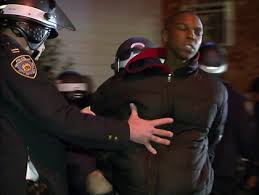
imagesIf Bill Bratton’s record in Los Angeles is any guide, New York will see little dramatic reduction in the police tactic of stop-and-frisk but improved targeting and community relations will soothe resentment.

New Yorks newly named police commissioner presided over a surge of stop-and-frisk while running the LA police department but softened the political impact by reaching out to black and Latino community leaders.

Mayor-elect Bill de Blasio, who was elected on a promise of curbing the controversial tactic, appears to be calculating his appointee will finesse but not end it. Critics say the policy in its current form unfairly targets young minority men, an accusation which dogged the outgoing mayor, Michael Bloomberg.

Bratton, 66, who served as New Yorks police commissioner from 1994 to 1996 before moving to LA, repeated his support for stop-and-frisk in a briefing to reporters on Thursday, saying it should be used in correct doses, like chemotherapy.

“At a time when police and community should be so much closer together, that there should be a bond of legitimacy and trust between them, its not the case in so many communities in this city. Its unfortunate. But it can be corrected.”

During his 2002-2009 stint in LA, he had helped bring “a police force that was literally at war with its African American community … to a position now … where there has been incredible improvement in those relationships,” he said. “That can happen and will happen here in New York City.”

Read More Bill Bratton seeks good community relations to make stop-and-frisk work | World news | theguardian.com.

Posted in News from the Soul Brother | Tagged , , , , , , , , | Leave a comment

The United States of financial insecurity

100 Dollars

(Photo credit: 401(K) 2013)

By Suzy Khimm

Five years removed from the financial crisis, most Americans no longer feel they’re drowning in debt. But a new poll shows they still have that sinking feeling when it comes to long-term finances—and they feel Washington is only hurting matters.

Here’s the good news: a whopping 90% believe they are realistically able to pay their day-to-day bills, and 68% believe they can make their mortgage payments, according to a Heartland Monitor poll commissioned by Allstate/National Journal. Despite that gloomy outlook on the economy at large—more than half of respondents believe we’re still in a recession—Americans are also modestly optimistic about their financial future in the near term: 39% believe their personal financial situation will improve over the next year. Only 15% believe it will get worse.

And there’s lot of evidence to show that Americans are getting better at paying down debt and avoiding delinquency—with the glaring exception of student loans. The average household is now spending about 10.5% of their post-tax income servicing their debt, the lowest level in 30 years, according to Ethan Harris, head of North America economics at Bank of America Merrill Lynch.

But Americans are still feeling anxious about their long-term finances, as many don’t have the means to accumulate savings and wealth for the future. Nearly 40% say it’s not realistic for them to invest their money for the future, as they can’t afford to, according to the Heartland Monitor poll.

Only 37% have a employer-backed 401(k), and an even smaller percentage have an IRA or a personal investment account. Many are still afraid to even make the jump: 42% say it’s too risky to rely on personal investments to pay for their retirement—the same number as in March 2009, during the darkest months of the economic meltdown. And just half of Americans have enough savings to last them six months in case of an unexpected job loss or health emergency.

“They don’t have jobs. And the people who have jobs—the high unemployment is hurting their wage growth,” Heidi Shierholz, an economist at the Economic Policy Institute, said at a discussion of the poll’s findings. ”They’re spending the money they have right now.”

Such figures help explain the rapidly growing wealth gap between the richest households in the U.S. and everyone else—a divide that’s twice as large as the income gap. “Dow 16,000 is a driving force in runaway wealth inequality,” says Justin King, policy director for the New America Foundation’s asset-building program. “The housing crash is the worst for the middle and lower class, since all their eggs were in that basket, and since wages aren’t going anywhere, there’s no excess capacity for ordinary [people] to put into building up wealth.”

Read More The United States of financial insecurity | MSNBC.

Posted in News from the Soul Brother | Tagged , , , , , , | Leave a comment

Appreciate

1010263_674665179214809_1251836385_n

Posted in Soul Brother Presents | Tagged , , , , , | Leave a comment

Soulbrother’s Christmas Soul Jam II

7240334670_ffa5592f16_zWe are in the season of joy, blessings, and giving as we rush about enjoy this playlist.


Posted in Soul Brother Presents | Tagged , , , , | Leave a comment

Nelson Mandela changed the course of history – for South Africa and the US

Português: Brasília - O presidente da África d...

(Photo credit: Wikipedia)

By Jesse Jackson

President Nelson Mandela was truly a transformative force in the history of South Africa and the world. My heart weighs heavy about his transition, but we are reassured because his life was full, and we know the imprint he left on our world is everlasting.

If ever the teaching that “Suffering breeds character. Character breeds faith. In the end faith will not disappoint” rang true, it did in the life of Mandela.

Despite imprisonment in Robben Island for 25 years and 8 months, Mandela never lost faith in winning freedom for the South African people. Suffering breeds character.

Mandela was a transformational figure; to say he was a “historical figure” would not give him his full due. Some people move through history as being the “first this or that” – just another figure in a lineage of persons. To be a transformer is to plan, to have the vision to chart the course, the skills to execute. To be transformational is to have the courage of one’s convictions, to sacrifice, to risk life and limb, to lay it all on the line. “Historical figures” will reference Nelson Mandela.

I recall marching against apartheid with Oliver Tambo and the enormous rally at Trafalgar Square in November 1985. I later met with the prime minister, Margaret Thatcher to decry Britain’s economic, political and military support of the apartheid regime. Let us not forget that Britain, the US, all of the western powers, labelled Mandela a terrorist and steadfastly propped up the apartheid regime – they were on the wrong side of history. I appealed to her to support the release of Mandela, and departed for South Africa.

Read More Nelson Mandela changed the course of history – for South Africa and the US | Jesse Jackson | Comment is free | theguardian.com.

Posted in Soul Brother Presents | Tagged , , , , , , | Leave a comment

South Africa’s week of mourning for ‘outstanding son’ Mandela

The statue of Nelson Mandela in Parliament Squ...

The statue of Nelson Mandela in Parliament Square, London. Sculptor: Ian Walters (Photo credit: Wikipedia)

By Julian Borger, David Smith, and Harriet Sherwood

South Africa is set for a week of mourning after the death of Nelson Mandela, the most universally loved and revered leader in history, through a series of events to celebrate his life.

The president, Jacob Zuma, announced an extended schedule of activities, befitting Mandela’s status as South Africa’s most beloved son, starting with a day of prayer on Sunday and culminating in a state funeral expected to rival that of Pope John Paul II in 2005.

“We should all work together to organise the most befitting funeral for this outstanding son of our country and the father of our young nation,” said Zuma, anticipating the massive logistical challenge ahead.

The president announced a memorial service to be held at the FNB stadium in Johannesburg, the venue of the 2010 World Cup final, on Tuesday 10 December, which is expected to be broadcast around the world. Mandela’s body will then lie in state in Pretoria for three days, in a glass-topped coffin allowing well-wishers to pay their respects. A funeral will be held on 15 December, attended by world leaders including David Cameron, Barack Obama and Bill and Hillary Clinton.

Mandela’s final resting place will be the modest village of Qunu in the Eastern Cape, a place where Mandela wrote in his memoir, Long Walk to Freedom, that he had spent “some of the happiest years of my boyhood”.

The strength and breadth of Mandela’s global appeal was reflected by the range of tributes from world leaders, piling up with every minute that passed after his death at home in Johannesburg at 8.50pm (18.50 GMT) on Thursday night.

Presidents and prime ministers, from Washington to Beijing, Havana to Delhi, from Jerusalem to the West Bank, all claimed to draw inspiration from the South African legend. Mandela set a benchmark for statesmanship against which all others have been measured.

It is not just the powerful who mourn his death. Many people, interviewed around the world, expressed their sense of loss, and in many places gathered to pay their respects.

An impromptu shrine sprang up in London’s Trafalgar Square as people left flowers outside the South African embassy, scenes of countless anti-apartheid protests during his long imprisonment.

In Kiev, where Ukrainians have gathered for anti-government demonstrations around the clock for the past week, protesters took a moment to recall Mandela’s legacy.

Read More South Africa’s week of mourning for ‘outstanding son’ Mandela | World news | theguardian.com.

Posted in News from the Soul Brother | Tagged , , , , , , , | Leave a comment