3 Places To Live The American Retirement Dream

Retirement

(Photo credit: 401(K) 2013)

By Kathleen Peddicord

Perhaps you like the idea of stretching your retirement dollars as far as possible (who doesn’t?) and reducing your cost of living and of health care, while at the same time enriching and enhancing your quality of life, but you’re not up for learning a new language or putting up with the day-to-day challenges and frustrations of life in the developing world. Fair enough. “Going local,” as it were, in a new life overseas, isn’t for everyone.

That doesn’t have to mean that you have to give up on the idea of enjoying the benefits of retiring to a new country. In a handful of places that have emerged in recent years as top expat havens, it’s possible to enjoy many of the advantages of being retired overseas without having to cross over to what could be called a “local” lifestyle. These are places where the American lifestyle has been exported and where the day-to-day living probably resembles in many ways what you left behind back home.

Here are three top choices for exporting the American Dream with you when you retire overseas, three places where sizable communities of foreign, mostly American, retirees have established themselves and are rapidly expanding. Living in one of these three places, you could enjoy affordable and top-quality health care, an affordable cost of living, and the adventure of starting over somewhere new, but you wouldn’t have to learn to speak Spanish if you didn’t want to and the culture shock would be very controlled.

#1: Boquete, Panama

Some 3,000 foreigners live in this colorful mountain town, and migration continues. The number of foreign residents in Boquete is expected to increase to 10,000 by 2016.

What’s the attraction? Beautiful setting, good climate, straightforward pensionado rules (for all Panama), yes, but, mostly, the draw in Boquete is the established gringo community. This town has been referred to as Panama’s “Gringoland.”

In one private, gated, residential community in this region, amenities include a golf course, stables, and a small central town created specifically for foreign residents. Construction, for both the shared amenities and the individual homes, is to U.S. standards and with U.S.-style finished, fixtures, and fittings.

Read More 3 Places To Live The American Retirement Dream Overseas | Kathleen Peddicord.

Posted in News from the Soul Brother | Tagged , , , , , , | Leave a comment

My virginity mistake

By Jessica Ciencin Henriquez

(photo credit: The Guardian)

(photo credit: The Guardian)

I was 14 years old when I married Jesus. Not Jesus, the Panamanian who worked at Six Flags. I mean Jesus Christ, the Lord. My parents sent me off to Baptist youth camp in Panama City Beach for the week, and I came home with a tan and a purity ring. I sat with my legs crossed, cramped in a theater with 200 sweaty, sobbing teens as our pastor described the unwavering bonds of sex and why it should only be experienced within the confines of marriage.

The lyrics echoed in the background as he shouted about STDs and unplanned pregnancy from the pulpit. Cause I am waiting for you, praying for you darling, wait for me too, wait for me as I wait for you. One by one we each placed a ring on our fourth finger and made vows to an apparently bi-curious Jesus who took teenage husbands and wives by the dozen that night.

I didn’t buy into a word of it. Jesus as my husband: Were they kidding? But that ring! Silver and engraved with entwined hearts – everyone I knew was wearing one and I’d finally been given the opportunity to get my hands on it. And it wasn’t just the ring. This was a movement with T-shirts and hats and the added bonus of superiority over kids in school who couldn’t keep their clothes on, those sinners. After an intense and very detailed sex talk with my mother , where she stuttered and I blushed and we both used the word “flower,” I was terrified of sex. That and the slide show in sex ed didn’t help one bit. So I scribbled Jesus + Jess on my Bible cover, and I casually mentioned my virginity in daily conversations. I committed to the idea hoping it would ensure a successful marriage. Instead, it led to my divorce.

I don’t know many people these days who married still a virgin. But going to high school in the furniture capital of North Carolina, it didn’t seem so strange that I wore an engagement ring at the age of 19. People admired my decision to marry my college sweetheart and were enthusiastic about my goal of waiting until marriage to have sex. (He actually wasn’t a virgin, but he was willing to wait for me.) Over time, I’d watched my brothers and sisters in Christ lose sight of their celibacy around the time they felt the pull of raging hormones combined with slots of unsupervised co-ed time. But I pressed on in stubbornness until finally, the time had come to replace Jesus as my other half. Twenty may sound early to get married, but tell that to the girl who had her knees locked since puberty and the boy who spent years trying to convince her that just the tip didn’t count.

Read More My virginity mistake – Salon.com.

Posted in Soul Brother Presents | Tagged , , , , , , | Leave a comment

12 Years a Slave and the Obama Era

By Jonathan Chait

Adobe Photoshop PDFThis last weekend, I finally saw 12 Years a Slave. It was the most powerful movie I’ve ever seen in my life, an event so gripping and terrifying that, when I went to bed ten hours later — it was a morning matinee — I lay awake for five hours turning it over in my mind before I could fall asleep. I understand it not merely as the greatest film about slavery ever made, as it has been widely hailed, but a film more broadly about race. Its sublimated themes, as I understand them, identify the core social and political fissures that define the American racial divide to this day. To identify 12 Years a Slave as merely a story about slavery is to miss what makes race the furious and often pathological subtext of American politics in the Obama era.

While its depiction of physical torture has commanded the most attention, I found the psychological torture more disturbing. To make a person a slave requires making them complicit in their own subservience, through rituals of degradation, such as forcing them to clap their hands to mocking songs, dancing for their masters, or being stripped, or compared to animals. The one time Northup tries to escape, he wanders immediately onto a lynch party, which underscores the threat of violence lurking invisibly everywhere. (And the threat of the noose survived in the South a century past the threat of the lash.)

Notably, the most horrific torture depicted in 12 Years a Slave is set in motion when the protagonist, Solomon Northup, offers up to his master engineering knowledge he acquired as a free man, thereby showing up his enraged white overseer. It was precisely Northup’s calm, dignified competence in the scene that so enraged his oppressor. The social system embedded within slavery as depicted in the film is one that survived long past the Emancipation Proclamation – the one that resulted in the murder of Emmett Till a century after Northup published his autobiography. It’s a system in which the most unforgivable crime was for an African-American to presume himself an equal to — or, heaven forbid, better than — a white person.

Read More 12 Years a Slave and the Obama Era — Daily Intelligencer.

Posted in News from the Soul Brother | Tagged , , , , , , , , , | Leave a comment

How Bureaucrats Stand in the Way of Releasing Elderly and Ill Prisoners

By Christie Thompson

jailFormer inmate Veronica Barnes had three years left to serve in federal prison when she found out in January 2011 that her husband John was dying of pancreatic cancer. Doctors said it was inoperable. They gave him less than a year to live.

Barnes worried who would look after her children, who were four and five years old at the time. A social worker suggested she apply for compassionate release, a program that lets federal inmates convicted of nonviolent crimes who face “extraordinary and compelling circumstances” get out of prison early.

Barnes, 32, seemed to fit most of the criteria. She was in prison on a nonviolent drug charge, and there was no one to care for her children when her husband died.

Barnes had been living with her family in Yarnell, Ariz. and working at the local market when she was arrested in 2008. She plead guilty to intent to distribute methamphetamine, and was sentenced to six years in prison. At the federal prison camp in Phoenix, Arizona, she saw her children every week, completed a parenting class, took college courses, and graduated from a drug rehab program.

The assistant U.S. attorney who tried Barnes’ case said she believed it was “a sympathetic case,” and that Barnes was unlikely to reoffend. The warden at the prison camp in Phoenix supported freeing Barnes.

“Based on the ages of the children and the death of their father, the children are dealing with a doubly traumatic situation since their mother is not able to render support or care,” the warden wrote. “I am in favor of recommending Ms. Barnes for compassionate release so she may reunite with her young children during this difficult time.”

A year and three months after submitting her first application — and nearly eight months after her husband died — Barnes received a letter from the Bureau of Prisons’ central office. Her request had been denied.

Read More How Bureaucrats Stand in the Way of Releasing Elderly and Ill Prisoners – ProPublica.

Posted in News from the Soul Brother | Tagged , , , , , , , , | Leave a comment

It’s the Wages, Stupid

100 Dollars

(Photo credit: 401(K) 2013)

By Daniel Gross

Welcomed by the left, and sure to be jeered or ignored by the right, it was full of plenty of old-time Democratic economic gospel and present-day center-left thought leadership. But it was a little bit light on the main factor that can combat the scourge of low wages and rising inequality: an appeal to the conscience and self-interest of businesses.

There was nothing new, or even objectionable, in the speech, which took a circuitous historical route to its subject. The U.S. has typically accepted greater inequality because we had a great deal of social and economic mobility. But the data behind that has clearly broken down, he argued. And that’s bad for America for a host of reasons. Countries with greater income inequality tend to have more frequent recession. Income inequality is bad for social cohesion, “not just because we tend to trust our institutions less but studies show we actually tend to trust each other less when there’s greater inequality.” And it’s bad for democracy.

The solution he offered is basically what has been the Democratic growth agenda for the last two decades. (It’s all there in Gene Sperling’s 2006 book, The Pro-Growth Progressive) That agenda includes “simplifying our corporate tax code,” more trade, smarter regulation, better skills and education, universal pre-school, more support for unions, bolstering retirement security, aid to urban areas and the unemployed, inter alia.

Read more  It’s the Wages, Stupid.

Posted in News from the Soul Brother | Tagged , , , , , | Leave a comment

How Wall Street Power Brokers Are Designing the Future of Public Education as a Money-Making Machine

By Anna Simonton

abcGiven that Arthur Rock has a net worth of $1 billion, lives in California and spends his time heaping money on tech startups (with the mantra, “Get in, get out,” as his guide), a local school board race in Atlanta, Ga. seems an unlikely candidate for his attention.

Yet there is his name, on the campaign finance disclosure reports of four candidates—two of whom were elected in November, and two who won a runoff on December 3—for the board of Atlanta Public Schools. On each report, two columns over from his name, the sum of $2,500 is listed, the maximum allowable amount.

The APS race was a pivotal one for Atlanta, a city still dealing with the fallout of a cheating scandal that thrust its public school system into the national limelight. Only two incumbents were re-elected to the nine-seat board.

The biggest question facing the board of newcomers is to what degree they will embrace charter schools. Last year, Georgia voters passed a constitutional amendment that enabled the creation of a state-appointed commission authorized to bypass local and state school boards in approving new charter schools. Critics say the measure passed because the text on the ballot, written by governor Nathan Deal, referenced “parental involvement” and “student achievement,” but not the specific authorities of the commission. In this climate, APS, which already has the most charter schools of any Georgia school district, will only avoid becoming the next laboratory for corporate education reform with significant pushback from the new school board.

That’s where Arthur Rock comes in. And a lot of other rich people, too.

Rock is not the only name on the reports with financial power and a less than obvious connection to Atlanta Public Schools.  Greg Penner of the Walmart empire, Dave Goldberg of the Sheryl Sandberg empire (they’re married), and Kent Thiry of the DaVita kidney dialysis empire (it sounds inglorious, but he pulls in $17 million annually), are among the names that had some Atlantans scratching their heads this election season.

Michelle Constantinides has three children in Atlanta Public Schools, and was alarmed by the level of corporate influence in the race. She explains her worry is not that donors will directly dictate board members’ decisions: “It’s much more sophisticated than that,” she says. Rather, “it’s about building a relationship with people and making them feel comfortable, and then once they feel comfortable, coming in and providing a service.”

Read More How Wall Street Power Brokers Are Designing the Future of Public Education as a Money-Making Machine | Alternet.

Posted in News from the Soul Brother | Tagged , , , , , , | Leave a comment

Abortion Restrictions Are Harming Women’s Health and Human Rights in Texas

Flag of Texas

Flag of Texas (Photo credit: Wikipedia)

By Andrea Flynn

Last week the Supreme Court decided to leave in place a Texas law that has essentially closed a third of the abortion providers in that state. On their own, the abortion restrictions are devastating. But in the context of three long years’ worth of family planning and women’s health cuts that violate the human rights of women in that state, they are catastrophic.

Over the summer Wendy Davis launched Texas into the national spotlight when she filibustered the same sweeping anti-abortion laws that were upheld by the Supreme Court. But long before that, women’s health advocates were sounding the alarm bells about the impact of massive family planning cuts that dismantled the state’s health infrastructure, on which millions of low-income women relied.

In order to understand the full implications of this week’s ruling, one must consider the current state of women’s health care – particularly that of low-income women – in Texas. The Center for Reproductive Rights (CRR) and the National Latina Institute for Reproductive Health (NLIRH) recently released a must-read report that illustrates the devastating human toll of family planning and reproductive health cuts on women living in Texas’s Rio Grande Valley.

The Valley is a marginalized region inside a state with some of the worst health disparities and the highest percentage of uninsured adults in the country. Many women in the Valley live in colonias, unincorporated communities along the U.S.-Mexico border, which often lack clean water, plumbing, electricity, and public transportation.

The report profiles women whose health and lives have changed along with the landscape of health infrastructures and systems in their communities. Women who detected lumps in their breasts four years ago but cannot afford the mammogram to determine if they are cancerous. Women who have received mammograms months ago but cannot get results because of exorbitant doctor’s fees. Women with ovarian cysts and cervical pain who risk their lives swimming across the river and traveling through towns rife with violence to access care in Mexico.

These women – and the thousands more they represent – must decide between paying rent, giving their children food and a roof over their heads, or having a mammogram, a Pap test, or contraceptives. “It’s one or the other, but not both,” they say. They live with a constant din of anxiety and fear, not knowing what disease is or might be growing in their bodies, where they will get care in emergency situations, or what will happen to their children if they become sick (or worse).

Read More Abortion Restrictions Are Harming Women’s Health and Human Rights in Texas | Next New Deal.

Posted in News from the Soul Brother | Tagged , , , , , , , , , | Leave a comment

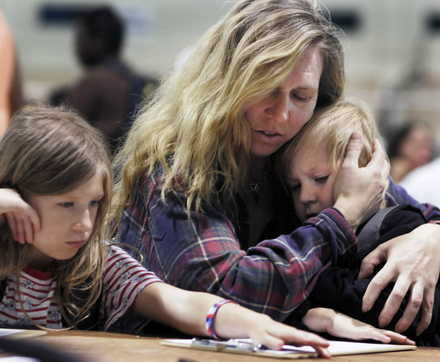
Millions of Americans Have No Food at Holiday Time

By Edward Wyckoff Williams

080604_Americans_hungryIt is a strange and ironic truth that in the world’s richest democracy, many Americans are going to work in the morning, but they and their families are going to bed hungry at night.

As Christmas fast approaches, and the warming memories of Thanksgiving dinner give way to yet another work week, it is a humbling reminder—and a necessary one—that not all of us have much to be thankful for this holiday season.

According to research compiled by the U.S. Department of Agriculture 14.9 percent of Americans are food-insecure. This accounts for 50 million Americans—around one in six—living in a household that is at risk of hunger. And of those, 17 million are children.

And Congress just made it worse.

On Nov. 1, food-stamp benefits shrunk by an average 5 percent for recipients, when the boost in benefits from President Obama’s 2009 American Recovery and Reinvestment Act ended. House Republicans have aggressively campaigned against extending these benefits, despite the fact that many of their own constituents—who are largely white, and mostly Southern—depend on food stamps to support themselves and their families.

They’re cutting benefits at a time that the number of people in need is increasing exponentially: A 2011 report by the USDA found that 5.5 percent of Americans, or nearly 17 million, suffered “very low food security,” which meant they had to skip meals or not eat for a day. That reflected a rise of 800,000 over the prior year.

In a Gallup poll conducted in August of this year, 20 percent of U.S. adults said that they didn’t have enough money to buy the food their family needed at some point in the past year—worse than Britain, Germany and China.

Read More Millions of Americans Have No Food at Holiday Time – The Root.

Posted in News from the Soul Brother | Tagged , , , , , , , | Leave a comment

Life

547772_10151672720507781_1234238454_n

Posted in Soul Brother Presents | Tagged , , , , | Leave a comment

Jessie J – Thunder

Posted in Soul Brother's Music Videos | Tagged , , , , , | Leave a comment