White House announces new executive actions on guns

By Carrie Dann

Hand Gun

(Photo credit: Leasepics)

The White House on Thursday announced two executive actions that it says will close loopholes that allow the most dangerous types of firearms from falling into the wrong hands.

The new policies come as legislative action on gun control appears completely stalled in Congress after a compromise background check bill was defeated in the Senate in April.

The first regulation from the Bureau of Alcohol, Tobacco, Firearms and Explosives would require background checks for guns registered to a trust or corporation. That action is intended to close a loophole that allowed felons and others who are prohibited from owning a firearm from bypassing the background check process, the White House said.

The second order will prevent the re-importation into the United States of military-grade firearms that have been provided to foreign allies.

Read More White House announces new executive actions on guns – NBC Politics.

Posted in News from the Soul Brother | Tagged , , , , , , , , | Leave a comment

Eric Holder Says DOJ Will Let Washington, Colorado Marijuana Laws Go Into Effect

Marijuana Small Amount

Marijuana (Photo credit: Wikipedia)

By Ryan J. Reilly & Ryan Grimm

The United States government took an historic step back from its long-running drug war on Thursday, when Attorney General Eric Holder informed the governors of Washington and Colorado that the Department of Justice would allow the states to create a regime that would regulate and implement the ballot initiatives that legalized the use of marijuana for adults.

A Justice Department official said that Holder told the governors in a joint phone call early Thursday afternoon that the department would take a “trust but verify approach” to the state laws. DOJ is reserving its right to file a preemption lawsuit at a later date, since the states’ regulation of marijuana is illegal under the Controlled Substances Act.

Deputy Attorney General James Cole also issued a three-and-a-half page memo to U.S. attorneys across the country on Thursday outlining eight priorities for federal prosecutors enforcing marijuana laws. According to the guidance, DOJ will still prosecute individuals or entities to prevent:

  • the distribution of marijuana to minors;
  • revenue from the sale of marijuana from going to criminal enterprises, gangs and cartels;
  • the diversion of marijuana from states where it is legal under state law in some form to other states;
  • state-authorized marijuana activity from being used as a cover or pretext for the trafficking of other illegal drugs or other illegal activity;
  • violence and the use of firearms in the cultivation and distribution of marijuana
  • drugged driving and the exacerbation of other adverse public health consequences associated with marijuana use;
  • growing of marijuana on public lands and the attendant public safety and environmental dangers posed by marijuana production on public lands;
  • preventing marijuana possession or use on federal property.

The eight high-priority areas leave prosecutors bent on targeting marijuana businesses with a fair amount of leeway, especially the exception for “adverse public health consequences.” And prosecutors have shown a willingness to aggressively interpret DOJ guidance in the past, as the many medical marijuana dispensary owners now behind bars can attest.

Read More Eric Holder Says DOJ Will Let Washington, Colorado Marijuana Laws Go Into Effect.

Posted in News from the Soul Brother | Tagged , , , , , , , | 3 Comments

Ten Ways Criminal Justice Is One Of The Great Civil Rights Crises Of Our Time

By Nicole Flatow

The last few months have issued several potent reminders that racism still pervades our criminal justice system, as even some prominent and powerful American black leaders publicly professed that they had to warn their young sons about police profiling. Supporting these anecdotes is a U.S. record of racially skewed criminal justice policies that moved academic Michelle Alexander to declare in her seminal 2010 book that mass incarceration is the new Jim Crow. On the 50th anniversary of the March on Washington, here are some of the many reasons criminal justice is in fact one of the great civil rights crises of our time:

1. The United States imprisons a larger percentage of its black population than South Africa did at the height of apartheid. More than 60 percent of people in prison now are racial or ethnic minorities, according to the Sentencing Project. These minorities are part of a total prison population that eclipses that of any other nation in the world. At the federal level, more than half of these individuals are locked up for nonviolent drug or immigration offenses.

2. Black men born in the United States in 2001 have a one in three chance of being incarcerated at some point in their lifetime, according to Department of Justice statistics. An even greater number will have a criminal record, and face the host of collateral consequences that emanate from a criminal record. As Alexander wrote, “An extraordinary percentage of black men in the United States are legally barred from voting today, just as they have been throughout most of American history. They are also subject to legalized discrimination in employment, housing, education, public benefits, and jury service, just as their parents, grandparents, and great-grandparents once were.” One study suggested felon voting restrictions disenfranchise more minorities than voter ID laws.

Read More  Ten Ways Criminal Justice Is One Of The Great Civil Rights Crises Of Our Time | ThinkProgress.

Posted in News from the Soul Brother | Tagged , , , , , , , | Leave a comment

Raising kids on McDonald’s wages: ‘Some days I’ve been up for 48 hours’

English: McDonalds' sign in Harlem.

McDonalds’ sign in Harlem. (Photo credit: Wikipedia)

Latoya Jemes was working the drive-thru line at a McDonald’s in downtown Memphis one night when a man leaned out of his car window and asked if she’d be interested in taking part in a strike.

Jemes hadn’t heard about the one-day fast-food strikes popping up in U.S. cities since the spring. But when the man, later identified as a worker organizer, showed her videos of the strikes in St. Louis and other cities, Jemes was inspired.

“I didn’t think it was possible, I felt like I could lose my job,” she said about the idea of not showing up to her shift in protest. “When I found out they couldn’t do anything about us going on strike, I feel much better about it now.”

Jemes, 24, certainly doesn’t want to lose her job. She currently spends her day caring for her 2-year-old, and then drops her three kids off at her mom’s home in the evenings before going to work from 10 p.m. to 6.30 a.m. She tries to catch a little sleep, and then wakes up to do her daughter’s hair before school. “Some days I’ve been up for 48 hours,” she said.

Jemes is one of the fast-food workers in a projected 50 cities who will be striking Thursday, in what fast-food worker organizers are billing as the largest fast food strike in American history. It’s the latest effort in an ongoing strategy by unions, worker advocacy groups and community organizations to raise wages and improve working conditions in an almost entirely non-unionized industry.

The single mom could use a raise. Jemes works the night shift at McDonald’s for $7.45 an hour. After she pays rent and utilities, she says she has $40 a paycheck to spend on her three kids — if she’s lucky. Jemes relies on food stamps, and can’t afford furniture in her home in the Whitehaven neighborhood of South Memphis. Her daughter only has a pair of sandals for shoes, which has Jemes worried about when it starts to gets cold.

“[McDonald’s] makes billions of dollars every year,” she said. “They could pay at least $8.50 or $9.”

In response to the strikes, the National Restaurant Association, the industry’s largest trade and lobbying group, has repeatedly emphasized the tight profit margins in the fast-food industry, claiming that significantly raising wages significantly would end up destroying jobs. The “other” NRA has flexed a lot of muscle to block state increases of the minimum wage.

Read More Raising kids on McDonald’s wages: ‘Some days I’ve been up for 48 hours’ | Al Jazeera America.

Posted in News from the Soul Brother | Tagged , , , , , , | 1 Comment

For Restaurant Workers, A Struggle To Put Food On The Table

English: This is actually Tom's Restaurant, NY...

his is actually Tom’s Restaurant, NYC. Famous as Monk’s in Seinfeld, and as Tom’s Diner, in the Suzanne Vega song of that name.(Photo credit: Wikipedia)

By Jennifer Ludden

Losia Nyankale, 29, didn’t mean to make a career in the restaurant business. But after two years of college, her schoolteacher mom lost her job and could no longer pay tuition. Then, Nyankale’s temp jobs in bookkeeping dried up in the recession. So she went back to her standby — restaurant work.

“I did some kitchen work. The pantries or the salad station,” she says. “I’ve also managed, supervised, wash dishes.”

These days, after her waitressing shift in a tony Washington, D.C. neighborhood, Nyankale picks up her 5-year-old son from school and her 4-year-old daughter from day care. Then it’s an hour-long trek on the subway and bus to Nyankale’s third-floor walkup apartment. She and the children’s father are separated, and he takes the kids on the weekends.

Nyankale started out in fast food, and joined such workers in a protest march in New York this past spring. The union-backed movement is asking for the right to organize, and for a pay increase to $15 per hour.

Nyankale is actually luckier than many restaurant workers; with tips, she can sometimes make that much. But she has cut back her hours — to 25 a week — to allow time with her children. The only way she can make ends meet now, she says, is through food stamps and subsidies for rent and child care.

Traditionally, the food and restaurant industry has been an entry point for young people, who then move up. But today, according to government figures, the average such employee is 29 years old. And, like Nyankale, nearly a quarter of them are parents.

Read More For Restaurant Workers, A Struggle To Put Food On The Table : The Salt : NPR.

Posted in News from the Soul Brother | Tagged , , , , , , , | Leave a comment

Join The Booming Dollar Store Economy! Low Pay, Long Hours, May Work While Injured

English: Exterior rendition of a Dollar Genera...

Exterior rendition of a Dollar General location (Photo credit: Wikipedia)

Dawn Hughey had worked at Dollar General for just four months when she was named manager of a store in the Detroit suburbs in 2009. Having recently moved home after a stint in California, Hughey hoped the new honorific — and its attendant annual salary — would help her start a new life in Michigan.

But like other managers in America’s booming dollar store industry, Hughey quickly came to believe she was a manager in name only. The major dollar store chains — Dollar General, Dollar Tree and Family Dollar — have thrived by offering customers rock-bottom prices that rival Walmart’s, a business model that requires shaving labor costs wherever possible. For a manager like Hughey, that meant working far beyond a 40-hour week.

Each week, the company allotted Hughey around 125 hours to assign to the four workers in her charge, most of whom were earning close to minimum wage, she said. But according to Hughey, as well as recent lawsuits against Dollar General and its competitors, the hours that dollar store managers are allowed to assign rarely cover the work that needs to be done. The stores operate on something close to a skeleton staff, workers say.

Pressured to keep payroll down, Hughey spent most of her time unloading trucks, stocking shelves and manning the cash register, often logging 12-hour days, six days a week, to keep the store operating. She said she felt less like a manager than a manual laborer.

Dollar General saved a bundle by having Hughey do much of the grunt work. As a salaried manager, she was exempt from overtime protections and didn’t get paid for extra work. Given that she often worked 70 hours a week, at an annual salary of $34,700, her pay sometimes broke down to less than $10 per hour — hardly a managerial haul.

She and her fellow store managers didn’t like thinking about the math, she said. After all, these were supposed to be the good, middle-class jobs in the low-paying retail world.

Read More Join The Booming Dollar Store Economy! Low Pay, Long Hours, May Work While Injured.

Posted in News from the Soul Brother | Tagged , , , , , , , , | Leave a comment

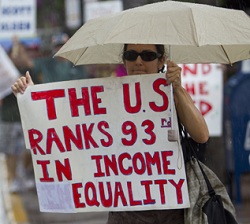
Where Have America’s Wages Gone?

By Richard (RJ) Eskow

Money, Hanging On

Money, Hanging On (Photo credit: cobalt123)

A new briefing paper from the Economic Policy Institute provides an overview of the income stagnation currently plaguing the vast majority of Americans. “A Decade of Flat Wages,” by Lawrence Mishel and Heidi Shierholz, offers valuable background on one of the under-reported stories of our time: the slow disappearance of the middle class and the loss of social mobility.

The critical question is why? Why has the economy failed so many people, and what can be done about it?

Stuck in the Middle

The authors state the problem clearly and concisely: “The wage and benefit growth of the vast majority … has stagnated, as the fruits of overall growth have accrued disproportionately to the richest households.”

As Mishel and Shierholz note, “The wage-setting mechanism has been broken for a generation but has particularly faltered in the last 10 years …” Corporate profits have reached historic levels and the top one percent of earners have captured virtually all income growth.

We don’t have a problem of inadequate wealth. The problem is inadequate wealth distribution. For 99 percent of Americans, wage growth has lagged significantly behind increases in productivity. As the authors note, this is true “regardless of occupation, gender, race/ethnicity, or education level.” Since the Great Recession productivity has grown by 7.7 percent, while wages have actually fallen for the bottom 70 percent of earners.

Read More Where Have America’s Wages Gone? | Richard (RJ) Eskow.

Posted in News from the Soul Brother | Tagged , , , , , , | Leave a comment

The High Probability of Being Poor in America

By Matt Bruenig

Wall Street Protests Fort LauderdaleLate last month, the Associated Press ran a report about economic insecurity that managed to gain some traction in certain parts of the political internet, and since then, again and again in certain relevant debates. The statistical bomb dropped in the first sentence of the report really says it all:

Four out of 5 U.S. adults struggle with joblessness, near poverty or reliance on welfare for at least parts of their lives, a sign of deteriorating economic security and an elusive American dream.

To be clear, this figure pertains to the percentage of people facing these problems at least once in their life, not the percentage of people facing them right now. Also, it should be noted that this figure cannot, by itself, be a sign of deteriorating economic security. To show things are deteriorating, you’d have to know whether this figure used to be lower than 80 percent, and we do not know that.

Shortly after the AP report blew up, the Wall Street Journal’s James Taranto responded with a few criticisms that are worth reading. Taranto argues that using near-poverty to derive the figure (meaning 150 percent of the poverty line) instead of the poverty line is arbitrary. Taranto also takes issue with the joblessness part of the figure because it counts even a day of joblessness, and takes issue with counting anyone who has ever received welfare benefits into the figure as well.

In light of Taranto’s criticisms, an interesting question presents itself: What would this figure look like if it did not include those features which Taranto objects to? If we used the poverty line instead of the near-poverty line and did not include joblessness or welfare receipt into the calculation, how much lower would the figure be? Lucky for us, in a variety of papers and books that came out in the late 1990s and early 2000s, Mark Rank and Thomas Hirschl published data on precisely this question.

Read More The High Probability of Being Poor in America | Alternet.

Posted in News from the Soul Brother | Tagged , , , , | 2 Comments

Congressman: The Jobless Are Like Lazy Kids Who Need To ‘Step Up’

English: US Rep. Steve King

US Rep. Steve King (Photo credit: Wikipedia)

By Alan Pyke

The trick to fixing the toughest job market since the Great Depression is to send jobless Americans to bed without supper, according to Rep. Steve King (R-IA).

Speaking in Charleston, South Carolina on Monday, after arguing that there are over 100 million Americans not even trying to find work, King said, “If you had six kids and a third of your kids would say, ‘I’m not doing the chores, mom… If any of them say I refuse, I’m not gonna participate, I’m not gonna contribute to the American GDP, pretty soon those kids would be on the ‘you get to eat after you do the work,’ not just in hopes that you might one day do the work.” After a brief diversion into immigration reform, King added, “I wanna see more Americans step up.”

Read More Congressman: The Jobless Are Like Lazy Kids Who Need To ‘Step Up’.

Posted in News from the Soul Brother | Tagged , , , , , , | Leave a comment

Reince Priebus: The future of the ‘Dream’

Posted in News from the Soul Brother | Tagged , , , , , | Leave a comment