The Big Cases At The Supreme Court That You Haven’t Heard About

By Ian Millhiser

(United States Supreme Court photo credit: Wikipedia)

(United States Supreme Court photo credit: Wikipedia)

The Supreme Court heard this term’s final day of oral arguments on Wednesday, a day that included a truly ghoulish debate over how states can execute death row inmates. By the first days of July, the justices will depart for their summer vacations. In the weeks in between, they could gut much of the nation’s civil rights law. They could cast many states’ election law into chaos. They could inflame our relations in the Middle East. And they could sentence thousands of Americans to die preventable deaths every year.

Here are major cases the justices are expected to decide by the end of June:

Race Discrimination And Housing

Probably the most undercovered major case this term is Texas Department of Housing and Community Affairs v. The Inclusive Communities Project, a case that could hobble the nation’s ability to combat housing discrimination.

Such discrimination is often very difficult to root out, which is why it persists in the housing sector. A study on behalf of the Department of Housing and Urban Development, for example, found that black and Asian homeseekers are shown or told about 15 to 19 percent fewer homes than whites who have similar credit or housing interests. Similarly, the Federal Reserve determined in 2009 that African Americans are twice as likely as white borrowers to be denied a home loan even when controlling for income and similar criteria. Yet discrimination persists in part because it is difficult to prove in court — banks typically do not produce smoking gun documents announcing that they prefer not to lend money to black people, for example.

Read More The Big Cases At The Supreme Court That You Haven’t Heard About | ThinkProgress.
Posted in News from the Soul Brother | Tagged , , , , , , , , , , , | Leave a comment

Baltimore Police Officer Calls For Community And Cops To Come Together, Tells Demonstrators: ‘I’m Here For You’

By Sebastian Murdock

In the days since thousands of protesters in Baltimore, Maryland have declared black lives matter and demanded an end to police brutality, one officer is reminding her community that working together is the only way to move forward.

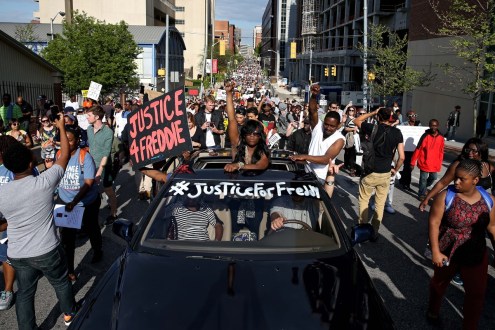
Sgt. K Glanville spoke to demonstrators Saturday night during a block party that was held on a day where massive crowds participated in a festive rally in the city. Revelers rejoiced following State Prosecutor Marilyn Mosby’s Friday announcement of criminal charges against the six officers involved in the death of 25-year-old Freddie Gray. Gray died on April 19 from a severe spinal cord injury he sustained while in police custody.

Mosby’s statement was unexpected but welcome news for the community, and gave way to an honest dialogue between a cop and the citizens she protects.

“My heart is in this,” Glanville told a small crowd. “I’m not wasting time on someone that’s not trying to let me in, when I got all these other people that got the door wide open, saying ‘Sgt. Glanville, please step in.’ I am here, I’m available. I give kids my phone number, I tell people ‘you need something, you call me.’ It all starts with relationship building.”

Glanville has been with the Baltimore Police Department for 19 years and has never received a complaint, she said. The officer, who has a degree in political science, told protestors that police and citizens need to start treating each other as human beings.

“You have to see past my uniform,” she said. “I’m somebody’s mother, I’m somebody’s daughter, I have parents, I’m human. You have to remember that I don’t just become a robot because I put this uniform on.”

Community members who gathered around Glanville could be seen hugging the officer, and at times tearing up.

Read More  Baltimore Police Officer Calls For Community And Cops To Come Together, Tells Demonstrators: ‘I’m Here For You’.

Posted in News from the Soul Brother | Tagged , , , , , , , | Leave a comment

Obama Finds a Bolder Voice on Race Issues

By Peter Baker

As he reflected on the festering wounds deepened by race and grievance that have been on painful display in America’s cities lately, President Obama on Monday found himself thinking about a young man he had just met named Malachi.

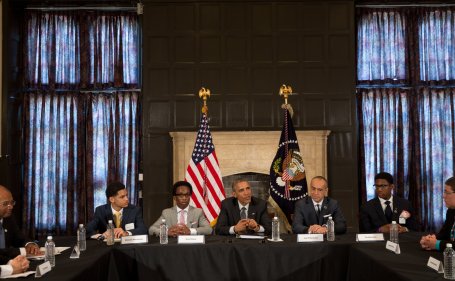
A few minutes before, in a closed-door round-table discussion at Lehman College in the Bronx, Mr. Obama had asked a group of black and Hispanic students from disadvantaged backgrounds what could be done to help them reach their goals. Several talked about counseling and guidance programs.

“Malachi, he just talked about — we should talk about love,” Mr. Obama told a crowd afterward, drifting away from his prepared remarks. “Because Malachi and I shared the fact that our dad wasn’t around and that sometimes we wondered why he wasn’t around and what had happened. But really, that’s what this comes down to is: Do we love these kids?”

Many presidents have governed during times of racial tension, but Mr. Obama is the first to see in the mirror a face that looks like those on the other side of history’s ledger. While his first term was consumed with the economy, war and health care, his second keeps coming back to the societal divide that was not bridged by his election. A president who eschewed focusing on race now seems to have found his voice again as he thinks about how to use his remaining time in office and beyond.

In the aftermath of racially charged unrest in places like Baltimore, Ferguson, Mo., and New York, Mr. Obama came to the Bronx on Monday for the announcement of a new nonprofit organization that is being spun off from his White House initiative called My Brother’s Keeper. Staked by more than $80 million in commitments from corporations and other donors, the new group, My Brother’s Keeper Alliance, will in effect provide the nucleus for Mr. Obama’s post-presidency, which will begin in January 2017.

“This will remain a mission for me and for Michelle not just for the rest of my presidency but for the rest of my life,” Mr. Obama said. “And the reason is simple,” he added. Referring to some of the youths he had just met, he said: “We see ourselves in these young men. I grew up without a dad. I grew up lost sometimes and adrift, not having a sense of a clear path. The only difference between me and a lot of other young men in this neighborhood and all across the country is that I grew up in an environment that was a little more forgiving.”

Read More  Obama Finds a Bolder Voice on Race Issues – NYTimes.com.

Posted in News from the Soul Brother | Tagged , , , , , , , , , , , , | Leave a comment

Video footage shows 4 black parole officers held at gunpoint by police

Posted in Uncategorized | 1 Comment

LGBT People of Color More Likely to Face Poverty

By Marisa Taylor

OrdinanceAgainstRainbowFlagDraftedinLouisianna070713

LGBT people of color face a high risk of suffering from poverty because of discrimination and lack of strong legal protections, according to a new report released on Thursday.

An estimated 3 million American adults identify as gay, lesbian, bisexual or transgender (LGBT) people of color, according to the report co-authored by the left-leaning Center for American Progress, a think tank, and the LGBT-focused advocacy group the Movement Advancement Project.

Black, Latino, Native American and Asian LGBT people are more likely to be poor than white LGBT people, the report said, with transgender people suffering from poverty most of all.

“Disproportionate numbers of LGBT people of color live in places that lack any explicit state-level protections for LGBT people,” Ineke Mushovic, executive director of the Movement Advancement Project, said in a release. “This means that LGBT people of color face a high risk of economic harm from anti-LGBT laws.”

While the report (PDF) said research in this area is limited, LGBT people of color are more likely than white LGBT people to suffer from poverty. For example, black Americans in same-sex couples are more than twice as likely to live in poverty than those in opposite-sex married couples.

Read More LGBT People of Color More Likely to Face Poverty | Al Jazeera America.

Posted in News from the Soul Brother | Tagged , , , , , | 1 Comment

How Raising The Minimum Wage To $15 Changed These Workers’ Lives

By Dave Jamieson

In late 2013, voters in this airport town outside Seattle narrowly approved a groundbreaking measure setting a minimum wage of $15 per hour for certain workers. When the new law went into effect last year, Sammi Babakrkhil got a whopping 57 percent raise.

A valet attendant and shuttle driver at a parking company called MasterPark, Babakrkhil saw his base wage jump from $9.55 per hour, before tips, up to $15. Having scraped by in America since immigrating from Afghanistan 11 years ago, he suddenly faced the pleasant predicament as his co-workers: What to do with the windfall?

For the overworked father of three, it wasn’t a hard question. Babakrkhil decided to quit his other full-time job driving shuttles at a hotel down the road. Though he’d take home less money overall, the pay hike at MasterPark would allow him to work 40 hours a week instead of a brutal 80 — and to actually spend time with his wife and three young girls.

“My kids used to not see me,” said Babakrkhil, who notes that the new work arrangement has also afforded him time to start exercising. “Now I make a little bit less, but I’m enjoying my life … I’m happy this way.”

Babakrkhil’s colleague Deyo Hirata, who also received a considerable raise, said he now frets less about making ends meet. Though he has always taken pride in his job and maintained a good relationship with his managers, he says the wage hike has made him feel better rewarded for his labor. Nobody will get rich earning $15 per hour in an area as expensive as greater Seattle, but for the first time now, Hirata is seeing the possibility of savings.

Read More How Raising The Minimum Wage To $15 Changed These Workers’ Lives.

Posted in News from the Soul Brother | Tagged , , , , , , , | Leave a comment

‘Baltimore For Real’: A Tour Through Troubled Sandtown

By Nurith Aizenman

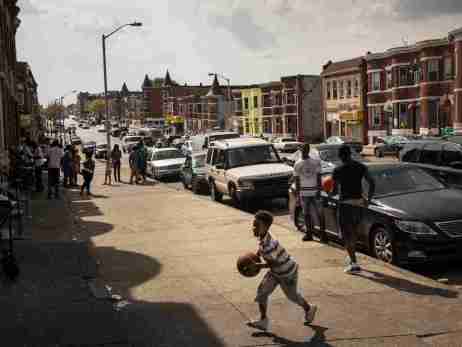
Travon Addison is an athletic 25-year-old, with short cropped hair, a wispy beard and tattoos all over his arms. I first spot him with a pack of his buddies in the lobby of Baltimore’s New Shiloh Baptist Church. Community leaders are trying to calm them down.

Addison had been arrested in the riot Monday, released two days later, and he’s come to the church because he’s heard they’re holding a summit on the problems that sparked the violence. He’s got a lot to say.

But they tell him only dignitaries are going to be speaking at this event — people like the mayor and the Rev. Al Sharpton. Addison and his friends will be introduced onstage, but they won’t really to get to say their piece. Afterward, Addison is frustrated.

“Y’all keep having all these press conferences,” he says. “But y’all ain’t talking to none of the youth that’s actually out there rioting. That don’t even make any sense! How you trying to find out why we rioting and y’all ain’t talking to us, y’all talking to some dude that wasn’t even there!”

The demonstrations in Baltimore turned into celebrations Sunday when the mayor announced that the curfew, in place since rioting on Monday, had been lifted. Residents also say they’re hopeful that charges brought against six city police officers in connection with Freddie Gray’s death will bring justice in his case and ensure future police accountability.

Read More ‘Baltimore For Real’: A Tour Through Troubled Sandtown : NPR.

Posted in News from the Soul Brother | Tagged , , , | Leave a comment

Baltimore’s Poor White Residents Harassment

By Wilson Dizard

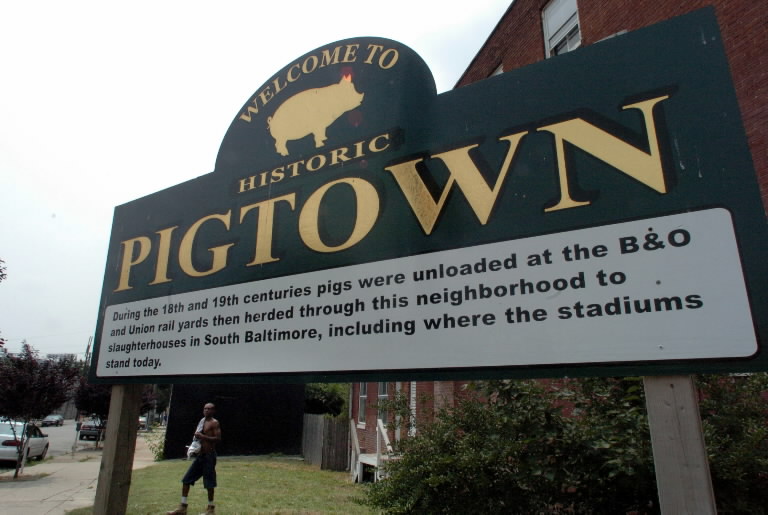
pigtown

Pigtown is a Baltimore neighborhood some two miles south of Sandtown, Freddie Gray’s neighborhood.

Gray’s death on April 19, a week after the 25-year-old black man was arrested and suffered injuries while in police custody, triggered mass protests against the treatment of Baltimore’s black communities by law enforcement. The protests escalated into violent unrest, and both local authorities and the Department of Justice are investigating the circumstances of Gray’s death.

In a city that is 63 percent black, Pigtown is a white enclave, created by migrants from West Virginia and western Maryland after World War II. What aligns it with Sandtown, where most residents are black, is poverty.

Pigtown’s white residents say that while skin color plays a role in who is targeted by police, they’ve come to believe police harass them as well because like Sandtown residents, they’re poor.

“We all get treated the same: badly,” said a 54-year-old woman who gave her name only as Sarah, as she sat on a stoop with her brother Roy. Both are white.

Michael Brown, 22, who grew up in Pigtown on the same street as Sarah and Roy, echoed his neighbor’s sentiment.

Because most Pigtown residents are poor, police assume they’re committing crimes, Brown said, treating black people as drug dealers and white people as drug buyers.

“Like you see how me and my daughter are sitting down on the front step? They’d pull up and act like this is not my house,” Brown said as he sat with his toddler on his stoop.

Read More Baltimore’s Poor White Residents Harassment | Al Jazeera America.

Posted in News from the Soul Brother | Tagged , , , , | Leave a comment

As investigation enters fifth month, Tamir Rice’s mother has moved into a homeless shelter

By Wesley Lowery

The City of Cleveland has asked the family of Tamir Rice, the 12-year-old boy shot and killed while he played with a toy gun in a Westside park in November, to halt their civil lawsuit until the official investigation has concluded.

The request, penned by city lawyers, says that delaying the lawsuit will protect the two officers involved in the shooting from making statements now, before knowing if they’ll be charged with a crime.

On Monday, Rice’s family responded: They can’t wait any longer.

In a court filing dated Monday, Rice’s family said they cannot agree to hold off on their lawsuit until the investigation is complete in part because they are worried that crucial evidence could be lost. In addition, they said, the elongated pace at which the investigation is moving is causing them sustained distress.

“The incident has shattered the life of the Rice family,” the motion stated.

Rice’s mother, the motion goes on to state, has moved into a homeless shelter.

Read More As investigation enters fifth month, Tamir Rice’s mother has moved into a homeless shelter – The Washington Post.

Posted in News from the Soul Brother | Tagged , , , , , , | Leave a comment

Help Baltimore by Restoring Voting Rights to Ex-Felons

By Ari Berman

Freddie Gray’s neighborhood in Baltimore had the highest incarceration rate of anywhere in the city. More than 450 adults from Sandtown-Winchester are in state prison, and one in four juveniles were arrested from 2005 to 2009. These statistics are indicative of a broader crisis in the city—a third of Maryland’s prison population is from Baltimore.

The problem of mass incarceration has been all over the news recently. One overlooked aspect of the story is how the legacy of mass incarceration denies equal citizenship long after the offenders have paid their debts to society. Nationally, 1 in 13 African-Americans—2.2 million people—are prohibited from casting a ballot because of felon disenfranchisement laws.

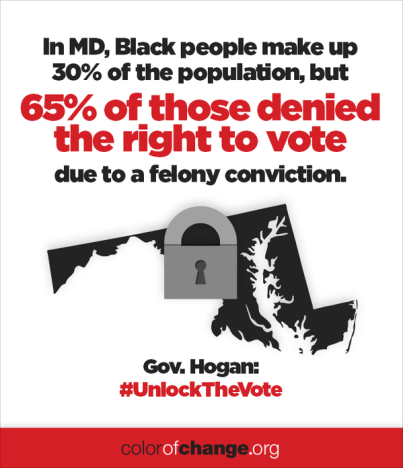
Earlier this month the Maryland legislature passed a bill automatically restoring voting rights for ex-felons, allowing them to vote while on parole or probation. The legislation would restore voting rights to nearly 40,000 people and be particularly beneficial to African-Americans, who make up 30 percent of the state’s population but account for 65 percent of those denied voting rights. The bill awaits the signature of Maryland Republican Governor Larry Hogan, who has said “I believe in second chances.”

Read More  Help Baltimore by Restoring Voting Rights to Ex-Felons | The Nation.

Posted in News from the Soul Brother | Tagged , , , , , , , , , | Leave a comment