Are Americans Really Champions of Racial Equality?

By Maribel Morey

Jonathan Ernst/Reuters

Jonathan Ernst/Reuters

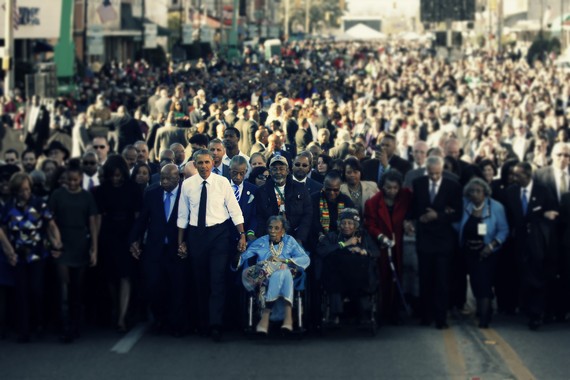
In his speech at Selma last month, President Barack Obama highlighted the inconsistencies between America’s egalitarian ideals and its history of racial discrimination. He stressed, though, that Americans have sought to correct their behavior to conform to their ideals: “The American instinct requires the occasional disruption, the willingness to speak out for what is right, to shape up the status quo. That’s America. That’s what makes us unique.” The idea that America’s moral failures on race are ultimately redeemed by its egalitarian ideals was popularized by Gunnar Myrdal’s 1944 work, An American Dilemma: The Negro Problem and Modern Democracy. The massive two-volume study has shaped the discussion of racial discrimination in the United States, from President Truman to President Obama.

Much of the impact of An American Dilemma stemmed from its impressive deployment of social science. The vast bulk of Myrdal’s project was devoted to presenting reams of data collected during his team’s three years of studying race relations in the United States. However, the idea that captured the nation’s imagination—that Americans are an exceptionally moral people whose history of racial discrimination is really one of moral failure and ultimate redemption—was not grounded in empirical social science research. Rather, it was an untested hypothesis intended both to motivate leading white Americans to address racial discrimination in the country and to burnish the image of the United States during the Second World War.

Americans today are quite aware of racial discrimination, but even a half-century after the civil rights movement, still uncertain how to address it. An American Dilemma popularized a flattering image of the American people, but its description of the American approach to race was an untested theory. Seventy years later, the public conversation on race continues to rely on an approach grounded more in wishful thinking than in hard fact.

Read More Are Americans Really Champions of Racial Equality? — The Atlantic.
Posted in News from the Soul Brother | Tagged , , , , , , | Leave a comment

Black death has become a cultural spectacle: Why the Walter Scott tragedy won’t change White America’s mind

By Brittney Cooper

The most recent coldblooded police slaughter of an unarmed Black man is not the story of “one bad apple.” I refuse to narrate this story as another “isolated incident.”

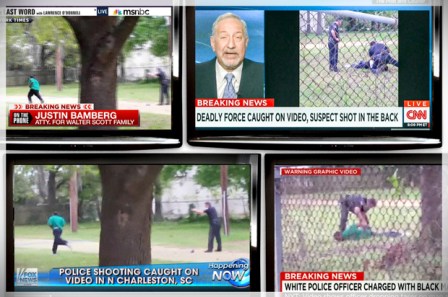
On Saturday morning, Michael Thomas Slager, a police officer in North Charleston, South Carolina, shot and killed Walter Scott, after pulling Scott over for a broken tail light. Slager initially claimed that he used his taser on Scott after Scott ran during the traffic stop. He then claimed that Scott tried to take his taser. Therefore, Slager was forced to use his gun.

But video shot by an anonymous bystander shows a very different, chilling version of events: As the video begins, the two men’s hands are interlocked. It’s unclear what is happening. But a second or so later, Scott breaks free and runs at a fairly slow pace away from the officer. Slager calmly pulls out his gun, aims and fires eight times at Scott’s retreating back. He then walks over to Scott’s now prone and bullet-ridden body, and handcuffs him, without offering him any medical assistance. Another officer, a Black man, arrives on the scene and also fails to administer any aid to the victim. Meanwhile, Slager, retraces his steps a few feet, picks up a dark object, widely believed to be the taser, casually saunters back over and tosses the object near the victim’s body. The nonchalance, the lack of urgency, is almost as unsettling as the murder itself. The casual way that Slager aims, fires and snuffs out Walter Scott’s life is devastating.

Read More Black death has become a cultural spectacle: Why the Walter Scott tragedy won’t change White America’s mind – Salon.com.

Posted in News from the Soul Brother | Tagged , , , , , , | Leave a comment

How a Broken Tail Light Can Be a Death Sentence in America

By Karen Dolan

brotSo now we know: A broken tail light can get you killed in America.

The situation that led to the alleged murder of Walter L. Scott by a white police officer in North Charleston SC is indicative of the crisis created by the growing criminalization of poverty in America and the persistent de-humanization of black people.

Poor people are targeted and aggressively policed for minor infractions such as the broken taillight on Mr Scott’s car. Poor black people are disproportionately targeted within this demographic. Once pulled over, other debts or warrants for similar misdemeanors may show up, resulting in arrest and jail time and increased spiraling of debt. Lives are ruined.

When you put that overwrought situation in the middle of racial profiling and aggressive police action against black men, you get the killing of Walter Scott.

According to the Center for American Progress, as of 2012, blacks were “twice as likely to be arrested, and almost four times as likely to experience the use of force during police encounters.”

The Bureau of Justice shows that black drivers are about three times more likely to be stopped by police than white drivers.

Read More How a Broken Tail Light Can Be a Death Sentence in America | Alternet.

Posted in News from the Soul Brother | Tagged , , , , , , , , | 1 Comment

American Police Killed More People in March (111) Than the Entire UK Police Have Killed Since 1900

By Shaun King

Yeah. Those numbers are real.A total of 111 people were killed by police in the United States in March of 2015. Since 1900, in the entire United Kingdom, 52 people have been killed by police.

Don’t bother adjusting for population differences, or poverty, or mental illness, or anything else. The sheer fact that American police kill TWICE as many people per month as police have killed in the modern history of the United Kingdom is sick, preposterous, and alarming.

In March:

Police beat Phillip White to death in New Jersey. He was unarmed.

Read More American Police Killed More People in March (111) Than the Entire UK Police Have Killed Since 1900 | Alternet.

Posted in News from the Soul Brother | Tagged , , , , , | Leave a comment

The Fight For The Soul Of The Black Lives Matter Movement

At a march in mid-December organized by Al Sharpton’s National Action Network in Washington D.C., organizers rushed the stage and claimed that the old guard was attempting to hijack the nascent Black Lives Matter movement away from its founders.

“This movement was started by the young people,” Johnetta Elzie, a key organizer from St. Louis, said to the raucous crowd. “There should be young people all over this stage.”

It was one of the most visible examples of the clash between the old, signified by Sharpton, and the new, represented by grassroots groups who emerged from Ferguson and New York after the Michael Brown and Eric Garner grand jury decisions.

Sharpton has been extremely sensitive to this criticism. “Oh, you young and hip, you’re full of fire. You’re the new face,” he sneered at a recent gathering at the headquarters of NAN in Harlem. “All that the stuff that they know will titillate your ears. That’s what a pimp says to a ho.”

At an MLK Day march in Harlem, the division between the old and the new was quieter but no less pronounced.

On Luxembourg Street, three cops stood behind a barricade, just a few feet away from a thousand protesters. One of the two female officers, brown skinned with accentuated eyebrows, plucked lint from the uniform of her stocky, white male colleague; they all laughed.

Meanwhile, a dozen or so protesters began to veer from a universal chant—one about justice being lost until it is found—to a more abrasive one: “How do you spell racist? N-Y-P-D.” It’s the same kind of chant Mayor Bill de Blasio called “hateful” and an “attempt to divide this city in a time when we need to come together” a week after two detectives were fatally shot in their squad car in Brooklyn. Immediately the three officers stiffened their backs and softened their smiles.

Minutes later, dozens of members of a group called Justice League NYC stormed past the officers on the sidewalk, led by some of its key staffers, with Councilmember Jumaane Williams at their side.

Seeing the group of well-groomed activists and politicians stroll by, the three officers relaxed and dropped their hands from their waists. The police seemed to know that for all the demonstrators’ bluster, it was going to be an uneventful day.

Read More The Fight For The Soul Of The Black Lives Matter Movement: Gothamist.

Posted in News from the Soul Brother | Tagged , , , , , , , | Leave a comment

Working, but Needing Public Assistance Anyway

Patricia Cohen

photo courtesy of http://foodstampsnow.com

photo courtesy of http://foodstampsnow.com

A home health care worker in Durham, N.C.; a McDonald’s cashier in Chicago; a bank teller in New York; an adjunct professor in Mayfield, Ill. They are all evidence of an improving economy, because they are working and not among the steadily declining ranks of the unemployed.

Yet these same people also are on public assistance — relying on food stamps, Medicaid or other stretches of the safety net to help cover basic expenses when their paychecks come up short.

And they are not alone. Nearly three-quarters of the people helped by programs geared to the poor are members of a family headed by a worker, according to a new study by the Berkeley Center for Labor Research and Education at the University of California. As a result, taxpayers are providing not only support to the poor but also, in effect, a huge subsidy for employers of low-wage workers, from giants like McDonald’s and Walmart to mom-and-pop businesses.

“This is a hidden cost of low-wage work,” said Ken Jacobs, chairman of the Berkeley center and a co-author of the report, which is scheduled for release on Monday.

Taxpayers pick up the difference, he said, between what employers pay and what is required to cover what most Americans consider essential living costs.

The report estimates that state and federal governments spend more than $150 billion a year on four key antipoverty programs used by working families: Medicaid, Temporary Assistance for Needy Families, food stamps and the earned-income tax credit, which is specifically aimed at working families.

Read More Working, but Needing Public Assistance Anyway – NYTimes.com.

Posted in News from the Soul Brother | Tagged , , , , , , , , | Leave a comment

UN unveils permanent memorial to victims of transatlantic slave trade

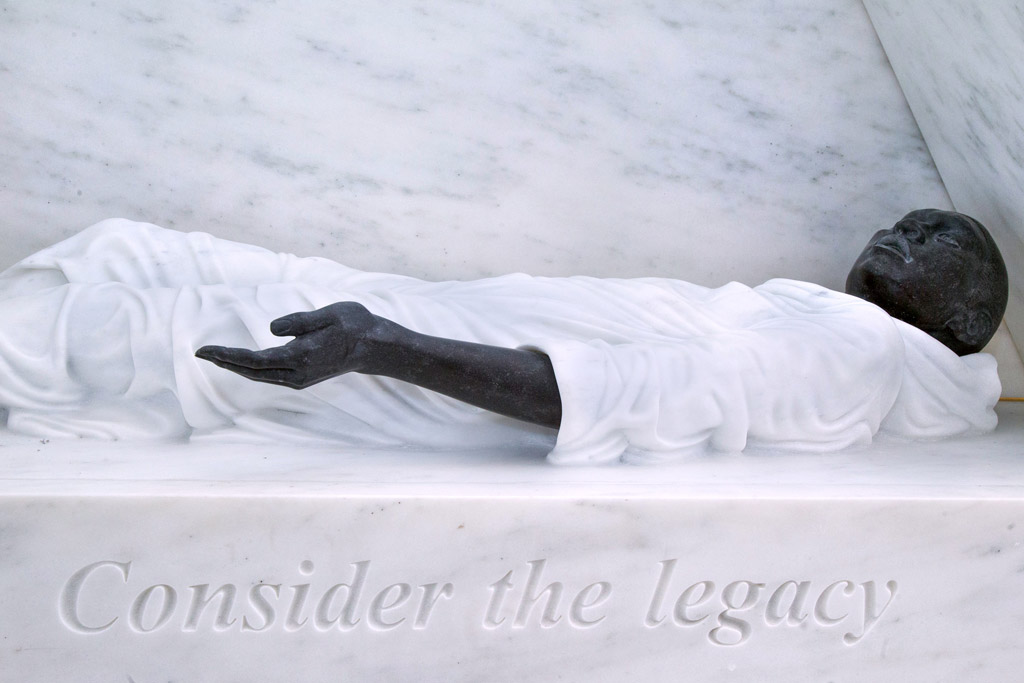
United Nations officials today welcomed the unveiling at the world body’s New York Headquarters of a permanent memorial to the victims of slavery and the transatlantic slave trade which they acknowledged was one of the most horrific tragedies of modern history.

“This memorial stands as a strong and permanent reminder – not only of this gross injustice but of the goals that the UN set for itself 70 years ago,” Secretary-General Ban Ki-moon said at the unveiling. “This poignant and powerful memorial helps us to acknowledge the collective tragedy that befell millions of people. It encourages us to consider the historical legacy of slavery and, above all, it ensures that we never forget.”

He pointed to the UN’s educational work, teaching students about the transatlantic slave trade through the ‘

’ and ensuring they appreciate how intolerance and racism can easily breed acts of hatred and violence.

“I hope descendants of the Transatlantic Slave Trade will feel empowered as they remember those who overcame this brutal system and passed their rich cultural heritage from Africa on to their children,” Mr. Ban said, while also issuing a call to honour women of African descent, noting that a third of those sold as slaves from Africa were female.

Read More United Nations News Centre – UN unveils permanent memorial to victims of transatlantic slave trade.

Posted in News from the Soul Brother | Tagged , , , , , , , , , , | 2 Comments

Surprise! Black Voters Just Won A Voting Rights Case In The Supreme Court

By Ian Millhiser

(United States Supreme Court photo credit: Wikipedia)

(United States Supreme Court photo credit: Wikipedia)

Alabama’s legislative maps, which minimized black voters’ influence by packing these voters into a small number of districts, will get another day in court thanks to a 5-4 decision — Justice Anthony Kennedy crossed over to vote with the Court’s liberal bloc — that the Supreme Court handed down on Wednesday. Though the Court’s decision in Alabama Legislative Black Caucus v. Alabama does not necessarily ensure that the state’s maps will be struck down, it rejects a lower court’s reasoning which upheld the unusual, racially focused method the state used in drawing many of its districts.

As Justice Stephen Breyer explains in the Court’s opinion, Alabama’s maps were the product of two considerations. First, the state “sought to minimize the extent to which a district might deviate from the theoretical ideal of precisely equal population” with respect to the state’s other districts (a goal Breyer characterizes as desirable). Additionally, the state purported to believe that it was required, under the Voting Rights Act, to “maintain roughly the same black population percentage in existing majority-minority districts.” Thus, for example, after determining that one overwhelmingly black district needed an additional 16,000 voters to comply with the goal of equal population, “Alabama’s plan added 15,785 new individuals, and only 36 of those newly added individuals were white.”

Read More Surprise! Black Voters Just Won A Voting Rights Case In The Supreme Court | ThinkProgress.

Posted in News from the Soul Brother | Tagged , , , , , , , , , | 1 Comment

The City That Believed in Desegregation

By Alana Semuels

Hawthorne Elementary in Louisville, Kentucky, looks like what you might imagine a typical American suburban elementary school to be, with students’ art projects displayed in the hallways and brightly colored rugs and kid-sized tables and chairs in the classrooms. It’s located in a predominantly white neighborhood. But the students look different than those in many suburban schools across America. Some have dark skin, others wear headscarves, others are blonde and blue-eyed. While many of them qualify for free and reduced lunches, others bring handmade lunches in fancy thermal bags and come from well-off families.

Ever since a court forced them to integrate in the 1970s, the city of Louisville and surrounding Jefferson County have tried to maintain diverse schools.Louisville and Jefferson County have tried to maintain diverse schools. Though the region fought the integration at first, many residents and leaders came around to the idea, and even defended it all the way up to the Supreme Court in 2006.

“Because the Metro area has a countywide system of public schools that are truly unitary,” the district argued in that case, Meredith v. Jefferson County Board of Education, “it has avoided much of the race-based strife and race-conscious decisions that characterize other metropolitan areas with highly segregated schools.”

The Supreme Court decided against Jefferson County, ruling in favor of a parent who argued that her son’s bus ride was too long. But in the years since, the district has found other creative ways of keeping its schools diverse. Today, the Louisville area is one of the few regions in the country that still buses students among urban and suburban neighborhoods. Jefferson County Public Schools is 49 percent white, 37 percent black, and 14 percent Latino and other ethnic and racial groups.

The county, which borders Indiana on the south, spreads across 400 square miles and encompasses census tracts in which more than half of the population lives below the poverty level, and tracts in which less than 10 percent does. But there are no struggling inner-city schools here—the city and county schools are under the same district, and the most sought-after high school within it, duPont Manual, is located near downtown.

Indeed, it could be argued that Louisville, an economically vibrant city in a highly conservative and segregated state, is a success today in large part because of its integrated schools and the collaborations among racial and economic groups that have come as a result. “Our PTA president will drive downtown into neighborhoods she probably would not have gone to, to pick up kids to bring to her house for sleepover,” said Jessica Rosenthal, the principal at Hawthorne Elementary. “I just don’t know how likely that is to happen in a normal school setting.”

Read More The City That Believed in Desegregation – The Atlantic.

Posted in News from the Soul Brother | Tagged , , , , , , , , , | 1 Comment

Fleece Force: How Police And Courts Around Ferguson Bully Residents And Collect Millions

By Ryan J. Reilly & Mariah Stewart

“Lacee Scott?” the judge called. The 23-year-old rose from a hard black plastic chair, walked past the fireplace and stood before the table at the front of the living room.

From the outside, the house is barely distinguishable from others on the street — brick, three bedrooms, built in 1948. Over the entrance, however, there is a sign identifying it as City Hall. Once a month, the living room, with its lamps, hardwood floors and clock on the mantle, becomes a courtroom. Those with business before the judge first check in with the clerk in the dining room before taking a seat among the rows of chairs set up in the family room.

Scott, a senior at Alabama A&M University, had lived in Pasadena Hills during high school. Her father, a former St. Louis County police officer, works for Walgreens. Her mother is the principal of a local elementary school. Last summer, when Scott was home visiting her family, a notice was placed on her car.

Parking had never been an issue in her quiet, suburban community. Pasadena Hills is small, with a population of less than 1,000. But the municipality had recently passed an ordinance requiring those parking overnight to display a $10 residential parking sticker on their vehicles. The notice ordered Scott to come to City Hall to obtain the sticker.

The city office has extemely limited business hours, however. The seven-hour drive from Huntsville, Alabama, back to Pasadena Hills also made it difficult for Scott to appear in person. Soon, the city began mailing her threatening letters.

“They sent me a letter and said there would be a warrant out for my arrest if I didn’t come back for this,” Scott told The Huffington Post of her court appearance. “For $10. For parking in front of my house.”

Such experiences are not uncommon in St. Louis County. According to a scathing report from the U.S. Department of Justice released this month, authorities in nearby Ferguson routinely abused the rights of residents, who were viewed “less as constituents to be protected than as potential offenders and sources of revenue.” Attorney General Eric Holder said the Ferguson Police Department had essentially served as a “collection agency,” with officers competing to see who could issue the largest number of citations.

Read More Fleece Force: How Police And Courts Around Ferguson Bully Residents And Collect Millions.

Posted in News from the Soul Brother | Tagged , , , , , , , , , , | 1 Comment