
By Barbara McNally

Mother & Daughter. courtesy of Madame Noire via Madamenoire.com
My mother’s talk about sex was nonexistent, like in many fundamental Christian homes. Her only words were, “Don’t do it. Why buy the cow when you can get the milk for free?”
So I was naïve and thought I should follow the church rules and wait until marriage to “serve” my man. It was about what I “gave up.”
I want my daughters to know that not all boys are threatening louts although some may be selfish lovers. Sex is not awful, and women are not property, plastic dolls whose destiny is controlled by our parents and then husband.
Now, I love sex. It’s fun. And because I love you, my daughter, I want you to have the same delights in life that I do.
You are a beautiful and self-sufficient woman, and I want you to use your smarts to make sound decisions about your body and your sexuality. I wish I had the same conversation with my mother about sexuality, but times were different back then. But you should never be afraid to speak your mind, at least not to me.
Please take these words to heart:
1. There is power in your choice. You should have confidence in sex because you are choosing to partake, so it’s empowering, not shameful. If we consciously admit we’re going to have sex, we are more likely to take responsibility for this freedom by using birth control. By denying our sexuality, like I did, you may still end up in bed, but without protection. Today the spread of AIDS and STDs, let alone the consequences of pregnancy when you’re not ready to be a mother, is devastating. So carry a condom. Don’t depend on the man to have one. Enjoy your sexual freedom, but take responsibility for it. I never want you to have to choose between having an abortion, giving up a child for adoption, or quitting your college or career to raise an unplanned-for child.
Read More 11 Things About Sex My Christian Family Hid from Me That I Want My Daughter to Know | Alternet.






 soulbrotherspeaks.com
Unfinished Business: 50 Years After the Civil Rights Act of 1964
http://www.gettyimages.com/detail/news-photo/marc-morial-ceo-of-the-urban-league-speaks-at-the-news-photo/104209228
By Marc H. Morial
“The purpose of the law is simple…those who are equal before God shall now also be equal in the polling booths, in the classrooms, in the factories, and in hotels, restaurants, movie theaters, and other places that provide service to the public.” – President Lyndon B. Johnson, July 2, 1964.
July 2 marked the 50th anniversary of President Lyndon Johnson’s signing of the landmark Civil Rights Act of 1964 that outlawed discrimination and segregation based on race, color, religion, sex, or national origin. First introduced by President John F. Kennedy shortly before his 1963 assassination, the Civil Rights Act offered greater protections for the right to vote and paved the way for another historic achievement one year later – the Voting Rights Act of 1965.
Momentum for the legislation picked up following the 1963 March on Washington where Dr. Martin Luther King Jr. and the National Urban League’s Whitney M. Young, along with 250,000 activists and citizens, gathered to demand “Jobs and Freedom” for people of all races who were locked out, left out, and disenfranchised.
President Kennedy, a Massachusetts liberal, introduced the bill in June 1963, just five months before his assassination. It was up to his appointed successor, Vice President Lyndon B. Johnson, a former United States Senator from Texas with deep southern roots, to carry it over the finish line. Despite extreme opposition, especially from his former southern Congressional allies, President Johnson successfully navigated the bill’s passage. He signed it into law surrounded by Dr. King, Whitney Young, and a multi-racial group of civil rights activists.
President Kennedy, a Massachusetts liberal, introduced the bill in June 1963, just five months before his assassination. It was up to his appointed successor, Vice President Lyndon B. Johnson, a former United States Senator from Texas with deep southern roots, to carry it over the finish line. Despite extreme opposition, especially from his former southern Congressional allies, President Johnson successfully navigated the bill’s passage. He signed it into law surrounded by Dr. King, Whitney Young, and a multi-racial group of civil rights activists.
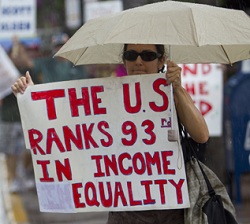
It was only 50 years ago that it was legal in some states to deny Blacks the right to eat in the same restaurants as Whites, to sit in the same movie theaters or even to apply for the same jobs. Thankfully, that is no longer true anywhere in America. We have also seen other gains, including a rising Black middle class and an increase in African-American high school graduation rates. However, there is still a wide opportunity gap in America.
Read More Unfinished Business: 50 Years After the Civil Rights Act of 1964 | Afro.