Ten Travesties Of Justice In 2013

By Nicole Flatow

jailEvery year, stories emerge that serve as a reminder that the American system of justice means injustice for too many, with some receiving little or no punishment for egregious offenses, while others receive harsh or faulty punishment for much less. Here are some of the worst injustices of 2013:

1. An Alabama blogger is still sitting in a jail cell for exercising his First Amendment rights

Blogger Roger Shuler drew the ire of the powers that be when he continued to write about the alleged extramarital affair of a prominent lawyer rumored to be running for Congress. The lawyer and son of former Alabama governor Bob Riley, Robert Riley, Jr., won a temporary restraining order that prohibited Shuler from writing anything about Riley’s alleged extramarital affair and other related stories. The order itself was almost certainly a violation of First Amendment law. But Alabama officials took the dispute a step further when they pursued him for a traffic stop and arrested him for contempt. In spite of advocacy from the ACLU and others, Shuler has now been in a jail cell for two months for his journalism.

2. A teen spent three years in jail without a conviction or trial

Kalief Browder was a 16-year-old sophomore in high school walking home from a party in the Bronx when he was arrested on a tip that he robbed someone three weeks earlier. He was hauled off to Rikers Island, a prison known for punishing conditions and overuse of force, and was held because he couldn’t pay the $10,000 bail. Browder went to court on several occasions, but he was never scheduled for trial. After 33 months in jail, Browder said a judge offered freedom in exchange for a guilty plea, threatening that he could face 15 years in jail if convicted. He refused. Then one day, he was released with no explanation. While Browder was behind bars, he missed years of his childhood, and is now aiming to attain his GED. Browder spent a particularly long time behind bars before his trial, but the practice of holding those charged but not convicted who cannot afford bail for months is all-too-common. In fact, the U.S. Supreme Court dismissed the appeal last term of a Louisiana man who waited seven years behind bars without a trial because the state stalled in appointing him a lawyer.

3. A man who killed an escort for refusing sex was acquitted by a jury

On Christmas Eve, Ezekiel Gilbert hired escort Lenora Ivie Frago and gave her $150 as what he believed was a payment for sex. But when she didn’t deliver that, Gilbert shot her in the neck and she died several months later from critical injuries. A jury acquitted Gilbert after his lawyer argued that he was authorized to use deadly force under a Texas provision that goes even farther than Florida’s Stand Your Ground law in authorizing the use of deadly force to “retrieve stolen property at night.” As in any jury trial, we’ll never know if that’s the reasoning the jury accepted when it acquitted Gilbert. Regardless, he will not face any criminal penalty for the shooting.

Read More Ten Travesties Of Justice In 2013 | ThinkProgress.
Posted in News from the Soul Brother | Tagged , , , , , | Leave a comment

I’m One of the 22,000 Homeless Kids Living in New York

By William

(photo credit: www.metro.us)

(photo credit: http://www.metro.us)

I used to dread it when people at school asked me where I live or if we could hang out at my place. I would try to give my schoolmates a general response, maybe the name of a neighborhood, but they always pressed for more. I’ve been homeless on and off for most of my life. I’ve lived in New York City shelters twice for extended periods of time. Most of the other times my mother and I bounced from house to house of friends and relatives.

I remember one time we were living in a house with 15 people. It was a nice house, but not for 15 people. It was originally three bedrooms, but after we makeshifted it – changing the closets into rooms and stuff like that – we ended up with about seven “bedrooms”. Kids were always running around. Someone would bring in all these animals and then never take care of them. We had two bathrooms but one broke often. One even became a kind of prison for a cat that no one wanted. You would think someone would just take the cat to the ASPCA, but everyone was too lazy. The house fell into disarray. We couldn’t even get down the hallway without stumbling over trash.

Perhaps other students in my school lived like I did, but I never knew it. I recently heard about the New York Times profile of Dasani, an 11-year-old homeless girl. In some ways, I know how she feels. I, too, am one of the estimated 22,000 homeless students in the city.

Read More I’m One of the 22,000 Homeless Kids Living in New York | Alternet.

Posted in News from the Soul Brother | Tagged , , , , , | Leave a comment

The War on Poverty vs. Racism

By Imara Jones

povertyCiting the need to replace “despair with opportunity” 50 years ago this week President Lyndon Johnson declared a War on Poverty. His effort to roll back severe economic distress, along with a host of other Great Society programs, was the largest push to help Americans on the economic and racial margins since the Great Depression of the 1930s. Many of Johnson’s programs were key to creating economic possibility for millions who had never known it, and a whole host of them such as HeadStart, Medicaid, food stamps, and loans for higher education continue to do that. Given the success of the War on Poverty, and with half of all Americans either poor, near poor or at risk of poverty, a vast array of policies to promote economic fairness is needed yet again. But given the image of Johnson’s programs in the public mind, it may be that much harder to achieve them.

The key barrier to embracing the War on Poverty and to building public support for a renewed poverty effort is the fact that right from the start Johnson’s program has been maligned and stereotyped beyond recognition, with race forming a key part of the insult. Given the development of the War on Poverty, that’s no surprise.

Officially enshrined in the Economic Act of 1964, Johnson’s “War on Poverty” was inspired by and based on Bayard Rustin’s Freedom Budget. Rustin put together the Freedom Budget after organizing the 1963 March on Washington. The War on Poverty and the larger Great Society constitute nearly every major economic opportunity, health, education, food security, and housing program in existence today with the exception of Social Security. From the beginning Rustin and Johnson recognized that racial and economic justice go hand-in-hand.

Yet for the past 50 years the ridicule hurled at this essential down payment on economic justice has been incessant and harmful. Johnson’s chief rival for the 1964 presidential race, Republican Senator Barry Goldwater, kicked off the anti-War on Poverty campaign by saying that Johnson’s program was “a gimmick” to “divide Americans” in an election year. It’s carried on since then.

In the 1980s President Ronald Reagan, who’d taken up the conservative mantle of Barry Goldwater, rode to the White House on a promise to reverse the War on Poverty. While at 1600 Pennsylvania Avenue, Reagan often used rhetoric that was racialized to justify his move to curb certain anti-poverty programs and end others. To that end, the 39th president asserted incorrectly that the War on Poverty increased the number of poor, or of “dependency” as he called it, and that it encouraged black women in poverty to have children as teens.

With Reagan’s narrative holding sway, Democratic President Bill Clinton came under pressure in election-year 1996 to “mend not end” Aid to Families with Dependent Children (AFDC), commonly known as welfare. The bill he signed effectively cancelled AFDC and welfare as it was known no longer exists.

Read More The War on Poverty vs. Racism – COLORLINES.

Posted in News from the Soul Brother | Tagged , , , , , , , , , , , | Leave a comment

Kentucky County That Gave War On Poverty A Face Still Struggles

By Pam Fessler

President Johnson in Inez, Kentucky, April 24, 1964. (photo credit: Art Lies)

President Johnson in Inez, Kentucky, April 24, 1964. (photo credit: Art Lies)

Fifty years ago today, President Lyndon Johnson stood before Congress and declared an “unconditional war on poverty in America.” His arsenal included new programs: Medicaid, Medicare, Head Start, food stamps, more spending on education, and tax cuts to help create jobs.

At the time, 1 in 5 Americans was poor. Today, things are better, but tens of millions of Americans are still living at or below the poverty level. That raises the question: Did the war on poverty fail? In the coming year, NPR will explore this question and others about the impact and extent of poverty in the U.S., and what can be done to reduce it.

People in the isolated hills of Martin County, Ky., rarely saw outsiders, let alone a president. So when President Lyndon Johnson visited in 1964 to generate support for his proposed war on poverty, it was a big deal.

Lee Mueller, a young newspaper reporter at the time, recalls the crowds in downtown Inez, Ky., the county seat, waiting for the presidential party to arrive at an abandoned miniature golf course.

“It was just like a hayfield full of long grass. It looked like helicopters landing in Vietnam or something when they came over the ridge,” he says.

Mueller says the locals didn’t know their role in this new, domestic war. For the White House, though, coming to Martin County gave poverty a face — and a name.

“In this south-central mountain country, over a third of the population is faced with chronic unemployment,” says on Johnson’s visit. “Typical of this group is Tom Fletcher, his wife and eight children. Fletcher, an unemployed sawmill operator, earned only $400 last year and has been able to find little employment in the last two years.”

At the time, the poverty rate in this coal-mining area was more than 60 percent. Johnson visited the Fletchers on the porch of their home — a small wooden structure with fake brick siding. Photographers took what would become one of the iconic images of the war on poverty: the president crouched down, chatting with Tom Fletcher about the lack of jobs.

Fast-forward 50 years. The Fletcher cabin still stands along a windy road about 5 miles outside town. It now has wood siding and is painted orange. There’s a metal fence with a “no trespassing” sign to keep out strangers. There are lots of small houses and trailers along this road, but also some new, bigger homes that could be found in any American suburb.

Today, the roads here are well-paved. People say the schools and hospitals are much better than they used to be. Still, Martin County remains one of the poorest counties in the country. Its poverty rate is 35 percent, more than twice the national average. Unemployment remains high. Only 9 percent of the adults have a college degree.

Read More Kentucky County That Gave War On Poverty A Face Still Struggles : NPR.

Posted in News from the Soul Brother | Tagged , , , , , , | Leave a comment

NYC’s Unsolved Murder Victims Are Disproportionately Minorities

By Molly Redden

11170896-a-body-outline-drawn-on-a-footpath-by-chalk-with-a-city-in-the-backgroundJustice comes slower for homicide victims killed in New York’s poorer outer boroughs than it does for the denizens of rich, relatively homicide-free Manhattan.

That’s according to a New York Daily News investigation analyzing the number of homicide detectives the city assigns to assist local precincts during the critical first hours following a murder. The investigation also looked at how the city allocates the scarce resources of its cold case squad. Reporters found that there are 10 homicides detectives serving Manhattan South, an area where only 10 murders were reported in all of 2013—one homicide detective per case. By contrast, Brooklyn North, where 86 New Yorkers were murdered in 2013, has 17 homicide detectives—each handling an average of five cases.

The result is a staggering number of unsolved murders in Brooklyn, Queens, and Bronx precincts, the majority of which involve Latino or black victims. The News tallied 77 open murder investigations in Brooklyn, 39 in the Bronx, 26 in Queens, 15 in Manhattan, and two in Staten Island. The precincts with the most open murder cases are in Brookyln’s East Flatbush (10 out of 12 unsolved), Crown Heights, (nine out of 13 unsolved), and East New York (eight out of 17 unsolved) neighborhoods. The News found that 86 percent of last year’s homicides involving a white victim have been solved, compared with 45 percent of murders with a black victim and 56 percent of murders involving a Hispanic victim.

Read More NYC’s Unsolved Murder Victims Are Disproportionately Minorities | Mother Jones.

Posted in News from the Soul Brother | Tagged , , , , , , , , | Leave a comment

Thoughts

1017360_397214483724786_656869706_n

Posted in Soul Brother Presents | Tagged , , , , , | Leave a comment

Open-Hearted Beauty

Posted in Soul Brother Presents | Tagged , , , , , | Leave a comment

Parents Are The Hardest People To Please

Posted in Soul Brother Presents | Tagged , , , , , , | Leave a comment

Geeking Out: Uganda’s Women are Creating the Next Generation of Girl Geeks

By Mike Miesen

(photo credit: omniafrikan.com)

(photo credit: omniafrikan.com)

Young women are learning to program computers in the unlikeliest of places, developing apps that will help their neighbors—and themselves.

If not for a view of the ornate Uganda National Mosque or the sprawling, congested taxi park in the distance, it would be hard to tell that Outbox, a technology incubator and accelerator, is in a high-rise in Kampala (Uganda’s capital city) and not some non-descript office building in Silicon Valley.

The vibe is intense and laid-back all at once. Modern, cushy chairs and long conference tables are used by casually-dressed young people typing furiously on MacBooks in a quest to create the next big thing. Formidable, expansive blinds in cascading green, blue, red and yellow cover its floor-to-ceiling windows (evoking Google, an organization that partially funds the space through its Google for Entrepreneurs initiative).

At one of the long tables, a group watched quietly as Joldeen Mirembe, a tack-sharp 23-year old woman, presented her latest creation: a website. While everyone was notably relaxed, each had something to say, asking questions or merely pointing something out. A few offered constructive criticism, which Joldeen accepted with the zeal of someone hungry to learn.

A year ago, Joldeen didn’t know how to design a website or program an app. She had always wanted to learn how, but felt uncomfortable in the male-dominated computer science courses offered at her university. “Sometimes [when] you’re doing programs with boys, you find that girls are a little shy to come up if they don’t understand,” she explained to me after her presentation.

Read More Geeking Out: Uganda’s Women are Creating the Next Generation of Girl Geeks – The Daily Beast.

Posted in News from the Soul Brother | Tagged , , , , , , , , | Leave a comment

Senate Votes To Move Ahead On Extending Unemployment Benefits

By Scott Neuman

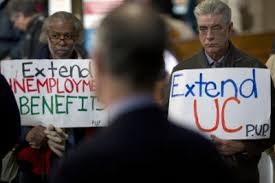
imagesA three-month extension of federal unemployment benefits for 1.3 million jobless Americans won a key procedural vote in the Senate on Tuesday.

The 60-37 vote indicates there’s enough Republican support to move the Emergency Unemployment Compensation, which expired on Dec. 28, forward to a full vote. As The Associated Press writes, the measure “is the leading edge of a Democratic program that also includes raising the minimum wage and closing tax loopholes on the wealthy and corporations.”

The vote does not guarantee final passage in the Senate and the measure still must clear the Republican-controlled House.

As NPR’s Craig Windham reported, GOP lawmakers opposed the bill because it does not include spending cuts to pay the cost of the extension.

The vote was originally scheduled for Monday evening, but it was abruptly delayed because, as Politico reports, supporters did not have the votes they needed.

On Monday, Politico wrote that Democrats needed five Republicans to join them to reach the needed 60-vote threshold, and at that time just two Republicans were in their column.

Speaking in the chamber just before the vote, Senate Minority Leader Mitch McConnell lashed out at the Democrats and President Obama:

“Remember: These are the same folks who gave us the stimulus, who gave us tax increases, and who gave us Obamacare,” he said. “All of it was done in the name of helping the little guy — in the name of greater equality. And what’s it given us? This mess.”

Read More Senate Votes To Move Ahead On Extending Unemployment Benefits : The Two-Way : NPR.

President Obama Speaks on Extending Emergency Unemployment Insurance

Posted in News from the Soul Brother | Tagged , , , , , , , | Leave a comment