The Most Likely Place a Child Will Be Killed by a Gun? Home.

By Mark Follman

imagesIn testimony given a few weeks after the mass shooting in Newtown, gun rights lobbyist Gayle Trotter emphasized to US senators that the best way for women to keep themselves and their children safe was to be armed. “An assault weapon in the hands of a young woman defending her babies in her home becomes a defense weapon, ” she said.

In terms of danger to children, Trotter couldn’t have been more wrong. According to our latest investigation, in the past year at least 194 kids ages 12 and under were killed by guns, in towns and cities across 43 states. And the vast majority of them were killed in homes—127 in their own, and another 30 in the homes of relatives, friends, or neighbors.

In 39 cases, children were shot intentionally in their own homes by their parents or adult guardians, accounting for more than a third of the 103 total homicides. And out of 84 total accidental shooting deaths, at least 49 involved kids handling a firearm left unsecured inside a home.

Moreover, when it comes to the accidental gun deaths of children, adults are rarely held criminally responsible. In 72 cases in which a child or teen pulled the trigger, killing themselves or other kids, we found only 4 cases in which an adult was convicted. Charges may still be pending in some cases. In part that may be because only 14 states and the District of Columbia have strong negligence laws with respect to children and firearms.

Read More The Most Likely Place a Child Will Be Killed by a Gun? Home. | Mother Jones.

Posted in News from the Soul Brother | Tagged , , , , , , , , | Leave a comment

The School Shootings You Didn’t Hear About—One Every Two Weeks Since Newtown

Crosses, flowers, signs, and other items left ...

(Photo credit: Wikipedia)

By Brandy Zadrozny

In the year since Newtown, at least 24 school shootings have claimed at least 17 lives, according to a Daily Beast investigation. Has anything really changed?

In the year since 20 first-graders were shot and killed at Sandy Hook Elementary, another school shooting has taken place in America every two weeks on average.

These events aren’t necessarily the types of tragedies that come to mind when one thinks of “school shootings”—madmen in fatigues roaming school hallways, strapped with automatic-style guns, murdering indiscriminately—nor do they receive the media attention of such mass shootings. But they can be similarly traumatizing for students and staff, and they have led to at least 24 injuries and 17 deaths over the past year, The Daily Beast has found.

Using data culled from media reports and collected in part by the gun-control advocacy group Moms Demand Action for Gun Sense in America, we tallied 24 school shootings during 2013—that is, shootings that occurred on school campuses when students were present. Shootings that took place after hours on school grounds were not included.

via The School Shootings You Didn’t Hear About—One Every Two Weeks Since Newtown – The Daily Beast.

Posted in News from the Soul Brother | Tagged , , , , , , , , | 1 Comment

When Lenders Sue, Quick Cash Can Turn Into a Lifetime of Debt

Payday Loans Neon Sign

(Photo credit: rinkjustice)

By Paul Kiel

A version of this story will be published in the St. Louis Post-Dispatch on Sunday.

Five years ago, Naya Burks of St. Louis borrowed $1,000 from AmeriCash Loans. The money came at a steep price: She had to pay back $1,737 over six months.

“I really needed the cash, and that was the only thing that I could think of doing at the time,” she said. The decision has hung over her life ever since.

A single mother who works unpredictable hours at a chiropractor’s office, she made payments for a couple of months, then she defaulted.

So AmeriCash sued her, a step that high-cost lenders – makers of payday, auto-title and installment loans – take against their customers tens of thousands of times each year. In just Missouri and Oklahoma, which have court databases that allow statewide searches, such lenders file more than 29,000 suits annually, according to a ProPublica analysis.

ProPublica’s examination shows that the court system is often tipped in lenders’ favor, making lawsuits profitable for them while often dramatically increasing the cost of loans for borrowers.

High-cost loans already come with annual interest rates ranging from about 30 percent to 400 percent or more. In some states, if a suit results in a judgment – the typical outcome – the debt can then continue to accrue at a high interest rate. In Missouri, there are no limits on such rates.

Many states also allow lenders to charge borrowers for the cost of suing them, adding legal fees on top of the principal and interest they owe. One major lender routinely charges legal fees equal to one-third of the debt, even though it uses an in-house lawyer and such cases usually consist of filing routine paperwork. Borrowers, meanwhile, are rarely represented by an attorney.

After a judgment, lenders can garnish borrowers’ wages or bank accounts in most states. Only four states prohibit wage garnishment for most debts, according to the National Consumer Law Center; in 20, lenders can seize up to one-quarter of borrowers’ paychecks. Since the average borrower who takes out a high-cost loan is already stretched to the limit, with annual income typically below $30,000, losing such a large portion of their pay “starts the whole downward spiral,” said Laura Frossard of Legal Aid Services of Oklahoma.

Read More When Lenders Sue, Quick Cash Can Turn Into a Lifetime of Debt – ProPublica.

Posted in News from the Soul Brother | Tagged , , , , , | Leave a comment

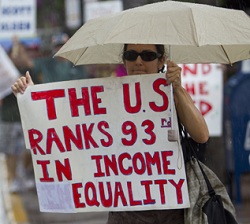
Local Government is the Secret Weapon in the Fight Against Economic Inequality

Wall Street Protests Fort LauderdaleBy Joelle Gamble

Americans don’t believe in guaranteed equal outcomes, but we do believe in equal opportunity and the ability to achieve a decent livelihood if one works hard. Unfortunately, the United States, despite being the world’s largest economy, is in the top quartile of the most unequal states, along with countries like Bulgaria, and is more unequal than all of Europe. In addition to high levels of income inequality, the United States still faces a jobs crisis, meaning that many people who want to work to achieve economic stability cannot find gainful employment.

Given the congressional gridlock impeding efforts to promote economic opportunity at the federal level, we should look to community-based solutions to mitigate our unsustainable levels of inequality.

Over the past several decades, political leaders have tried to stimulate the economy on the supply side. They have provided incentives for businesses to invest in capital improvements, loosened regulations to encourage business growth, and lowered tax rates to give investors an incentive to take risks and create jobs. But we do not have a supply-side problem.

Our problem is on the demand side. Average Americans have so little wealth that they cannot afford to consume what companies sell. Income inequality has grown to the extent that those who are not at the very top can no longer afford to participate in the market.

Hyper-partisanship and the special interests that fuel it make it impossible for the current Congress to address the declining wealth of America’s middle- and low-income communities. Just look to the Ryan-Murray budget compromise: Congress is refusing to extend unemployment insurance, claiming that an extension will discourage recipients from looking for new work, while at the same time, congressional Republicans complain that the president is not creating enough jobs for those same workers. While they focus on scoring political points, American workers continue to suffer.

Read More Local Government is the Secret Weapon in the Fight Against Economic Inequality | Next New Deal.

Posted in News from the Soul Brother | Tagged , , , , | Leave a comment

Mind

1044526_10151520483042781_30044046_n

Posted in Soul Brother Presents | Tagged , , , , , , | Leave a comment

Tamar Braxton – She Can Have You

Posted in Soul Brother's Music Videos | Tagged , , , , , | Leave a comment

Jhené Aiko – The Worst

Posted in Soul Brother's Music Videos | Tagged , , , , , | Leave a comment

Kid President’s Holiday Gift Guide

Posted in Soul Brother Presents | Tagged , , , , , | Leave a comment

SoftBank is lighting a fire under Sprint – I’ll be waiting for the results

English: Sprint Nextel logo

(Photo credit: Wikipedia)

By Phil Goldstein

Before SoftBank’s $21.6 billion deal to take control of Sprint (NYSE:S) was finalized, Sprint formally referred to the after-transaction company as “New Sprint.” Nearly six months after Sprint shareholders approved the deal, it seems like the new Sprint is finally starting to emerge. SoftBank, which now controls around 80 percent of Sprint, has given the No. 3 carrier a mandate to build the fastest and most robust LTE network in the U.S., and perhaps the world. Whether Sprint can deliver on that expectation will be the game to watch for all of 2014.

SoftBank’s influence over Sprint may be subtle but it’s clear that without the Japanese company’s money and input Sprint’s major network push for the future, its tri-mode LTE service dubbed “Sprint Spark,” would not be possible. Bob Azzi, Sprint’s chief network officer, acknowledged as much in a recent interview with FierceWireless, noting that the success of Spark relies mainly on a nationwide deployment made possible with Clearwire’s 2.5 GHz spectrum.

More importantly, Spark also relies on massive new 2.5 GHz radios with capabilities for 8 Transmitters 8 Receivers (8T8R), which Sprint has said will be the first deployment of its kind in North America. Azzi said Sprint’s network team worked with SoftBank technologists to glean lessons from SoftBank’s real-world deployment of TD-LTE on 2.5 GHz in Japan. The two teams collaborated on “specific technical nuances” of the radios. Additionally, Sprint and SoftBank also joined forces when it came to evaluating vendors for the new radios.

Azzi noted that SoftBank had much deeper experience with Nokia Solutions and Networks (NYSE:NOK), which had not been a vendor for Sprint’s Network Vision network modernization project. SoftBank not only recommended NSN but connected Sprint executives with counterparts at NSN more quickly and effectively than Sprint officials would have been able to by themselves. “It’s a better outcome than we would have gotten on our own,” he said.

Read More SoftBank is lighting a fire under Sprint – I’ll be waiting for the results – FierceWireless.

Posted in News from the Soul Brother | Tagged , , , , , , , , | Leave a comment

New York City rolling out nation’s largest free, public Wi-Fi network

English: Times Square

Times Square (Photo credit: Wikipedia)

By Tammy Parker

The Big Apple has big plans for public Wi-Fi as it rolls out a network that will cover 95 city blocks in Harlem and provide coverage to 80,000 residents as well as businesses and visitors to the area.

The office of New York City Mayor Michael Bloomberg claims Harlem WiFi will be the largest continuous free outdoor public wireless network in the United States.

The network will be deployed in three phases starting this month. The final phase is slated for completion in May 2014. The project is being overseeing by the city’s Technology Development Corporation and the Department of Information Technology and Telecommunications, which are working with technology provider Sky-Packets on the deployment.

The free network, which has an initial five-year term of service, is being funded by the Fuhrman Family Foundation. Increasing wireless is a key component of the Bloomberg administration’s efforts to ensure digital inclusion, said Rahul Merchant, city chief information and innovation officer.

Read More New York City rolling out nation’s largest free, public Wi-Fi network – FierceWirelessTech.

Posted in News from the Soul Brother | Tagged , , , , , , , , | Leave a comment