

(Photo credit: Wikipedia)
By Muhammad Ali
Mandela. One name. One man. One mission: Saving a nation from itself.
Few men in the history of mankind have had more impact on a nation and inspired the world.
Mandela.
He led his country from the viciousness of apartheid to the glory of a multiracial democracy, peacefully.
Has an individual ever given more to a nation and a cause? Only those who have sacrificed their very lives.
Mr. Mandela could have easily spent those 26 years of incarceration abroad, protesting the evil from afar, safe from repercussions. Not him. If his people suffered, he would suffer with them.
I know something about protest. I know well the feelings and questions that run through the mind of those who stand against a system, braving everything for a cause. It is never easy. The personal price is high, but the greatest of people persevere for the greater good. Modern South Africa is built on the back of Mr. Mandela’s sacrifice. It still amazes me, even to this day, that a man could give up two and half decades of his life, emerge from prison and forgive his imprisoners.
The Zulu word ndugu best describes him: my humanity is through you. Mr. Mandela was able, despite all the evil done to him, to see the humanity of those who punished him. He was able to look into their souls and see something worth redeeming. This is a lesson that should be learned by the world: There is humanity, even in the worst of us. If only the leaders of nations would embrace his method, there would be peace throughout the world. He proved there is always a way to reconcile differences.
As Mr. Mandela walked to freedom, I thought about him in that cell, brave and proud and unbroken, fueled only by the power of his beliefs for all those years. His iron resolve was a beacon for that nation, and on that great day, South Africans followed that powerful, inspirational light out of bondage.
Later, I was amazed to discover that Mr. Mandela used to listen to my fights when he was imprisoned on Robben Island. That humbling revelation moved me to tears. There he was, a king in exile, being lifted up by my ring exploits. Had I known he was listening to Ali-Frazier I, I probably would’ve beaten Joe that night. I was always the greatest when I was fighting for something.
Read More Tribute to Nelson Mandela | Muhammad Ali.




 soulbrotherspeaks.com
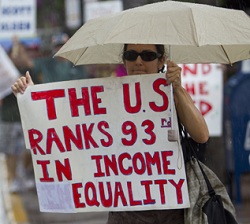
How To Use The Pope’s Agenda To Make The World More Equal
By John Halpin
As usual with Church teachings, it is very hard to fit the full range of Catholic thought into secular ideological boxes, particularly in the United States. For every papal pronouncement like “Just as the commandment ‘Thou shalt not kill’ sets a clear limit in order to safeguard the value of human life, today we also have to say ‘thou shalt not’ to an economy of exclusion and inequality,” there’s a deeply conservative social counterpart (e.g., “It is not ‘progressive’ to try to resolve problems by eliminating a human life”).
Apostolic exhortations like Evangelii Gaudium are basically calls to carry out existing Church teachings, so in many ways there’s nothing unique about the sentiments expressed in the document. The frontal assault on neo-liberal economic dogma and call for people to get out in the streets to evangelize the more communal and harmonious message of the Church will certainly spark a lot of discussion. But what really matters now is what progressives, Catholic and non-Catholic alike, plan to do with Francis’s exhortations. How do we ensure that the Pope’s shift in focus to inequality and the well-being of the poor becomes a focus of actual politics and not just a bunch of nice words that make us feel like our philosophical principles got a nod from the Big Guy?
One of the key moves in turning any important book, speech, or treatise into concrete political accomplishments is refining its principles into a core agenda and value system that people can educate and organize around. Luckily, Evangelii Gaudium is quite amenable to this treatment.
First, let’s talk about the Catholic concept of a “just wage.” The exhortation expresses important ideas about the dehumanizing nature of the modern economy and the social exclusion implicit in global capitalism. It also explicitly argues social welfare programs are not enough on their own and that we should reach higher for a “just wage,” a longstanding idea in American Catholic social thought dating back to the Progressive and New Deal eras. For Pope Francis, this means all people should “have adequate access to all the other goods which are destined for our common use” — expanding the notion of a “wage” well beyond simple renumeration. It’s a demand for both the government and corporations take seriously duties to provide “education, access to health care, and above all employment” to, respectively, citizens and employees.
Read More How To Use The Pope’s Agenda To Make The World More Equal | ThinkProgress.