
Martin Luther King and the Two 9/11s

By Ariel Dorfman

English: Dr. Martin Luther King giving his &qu...

Dr. Martin Luther King giving his “I Have a Dream” speech during the March on Washington in Washington, D.C., on 28 August 1963. (Photo credit: Wikipedia)

So much has changed since that hot day in August 1963 when Martin Luther King delivered his famous words from the steps of the Lincoln Memorial. A black family lives in the White House and official segregation is a thing of the past. Napalm no longer falls on the homes and people of Vietnam and the president of that country has just visited the United States in order to seek “a new relationship.”

A health-care law has been passed that guarantees medical services to many millions who, 50 years ago, were entirely outside the system. Gays were then hiding their sexuality everywhere — the Stonewall riots were six years away — and now the Supreme Court has recognized that same-sex couples are entitled to federal benefits. Only the year before, Rachel Carson had published her groundbreaking ecological classic Silent Spring, then one solitary book. Today, there is a vigorous movement in the land and across the Earth dedicated to stopping the extinction of our planet.

In 1963, nuclear destruction threatened our species every minute of the day and now, despite the proliferation of such weaponry to new nations, we do not feel that tomorrow is likely to bring 10,000 Hiroshimas raining down on humanity.

So much has changed — and yet so little.

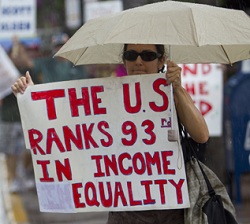
The placards raised in last week’s commemorative march on Washington told exactly that story: calls for ending the drone wars in foreign lands; demands for jobs and equality; protests against mass incarceration, restrictions on the right to an abortion, cuts to education, assaults upon the workers of America, and the exploitation and persecution of immigrants; warnings about the state-by-state spread of voter suppression laws. And chants filling the air, rising above multiple images of Trayvon Martin, denouncing gun violence and clamoring for banks to be taxed. Challenges to us all to occupy every space available and return the country to the people.

Yes, so much has changed — and yet so little.

In my own life, as well.

Read More  Tomgram: Ariel Dorfman, Martin Luther King and the Two 9/11s | TomDispatch.
Posted in News from the Soul Brother | Tagged , , , , , , , | Leave a comment

An Unfulfilled Demand From The March On Washington: A $15 Minimum Wage

By Bryce Covert

Wall Street Protests Fort LauderdaleWhen protestors gathered in the nation’s capital 50 years ago from Wednesday, they had ten concrete demands, one of which was “A national minimum wage act that will give all Americans a decent standard of living.” They also pointed out that research showed that “anything less than $2.00 an hour fails to do this.” A $2 minimum wage would be $15.27 an hour in today’s dollars.

Yet today’s minimum wage stands at $7.25, where it hasn’t budged for four years. And it has in fact fallen in value since Dr. Martin Luther King, Jr. made his “I Have A Dream” speech. If it had kept up with inflation since the 1960s, it would be over $10 an hour.

The low minimum wage has huge racial implications today as it did then. People of color make up 42 percent of workers earning that wage but just 32 percent of the overall workforce. If the minimum wage were raised to $10.10 an hour, they would be the majority of those lifted out of poverty, as it would raise wages for 3.5 million people of color.

Read More An Unfulfilled Demand From The March On Washington: A $15 Minimum Wage | ThinkProgress.

Posted in News from the Soul Brother | Tagged , , , , , , , | 2 Comments

1963 March on Washington

Posted in Soul Brother Presents | Tagged , , , , , , , | Leave a comment

U.S. seeking $6 billion from JPMorgan to settle mortgage claims: source

Jamie Dimon,  CEO of JPMorgan Chase

Jamie Dimon, CEO of JPMorgan Chase (Photo credit: jurvetson)

By David Henry, Margaret Chadbourn, Gary Hill, & Matthew Lewis

U.S. government housing finance authorities are pressing JPMorgan Chase & Co for at least $6 billion to settle lawsuits over bonds backed by subprime mortgages, according to a person familiar with the matter.

The company is arguing that it should pay less to settle the claims by the U.S. Federal Housing Finance Agency, according to the source, who was not authorized to speak for attribution.The FHFA litigation is among a raft of legal issues JPMorgan is trying to work through in addition to investigations over its $6.2 billion “London Whale” derivatives loss of last year.An FHFA spokeswoman declined to comment.The FHFA, which oversees Fannie Mae and Freddie Mac, sued JPMorgan over some $33 billion of securities two years ago and also sued at least 16 other financial institutions.The lawsuits alleged that the

via U.S. seeking $6 billion from JPMorgan to settle mortgage claims: source | Reuters.

Posted in News from the Soul Brother | Tagged , , , , , , , | Leave a comment

Secretive Companies Allow Hackers To Thrive: U.S. Attorney

By Gerry Smith

imagesSome American companies are still unwilling to report to law enforcement they have been hacked, a reluctance that is making it more difficult to combat cybercrime, a top federal prosecutor told The Huffington Post.

Preet Bharara, the U.S. Attorney for the Southern District of New York, chastised businesses last year for failing to disclose that their computer systems have been breached.

In an interview last week, Bharara told HuffPost that silence from hacking victims “is still an issue” and is often complicated by many factors, including the desire of companies to protect their stock prices and reputations.

“It’s not just a law enforcement problem; it’s a corporate culture problem also,” he said during an interview in his office in lower Manhattan, where he keeps a photo on the wall of his mother with his favorite musician, Bruce Springsteen.

“We can’t solve the problem overnight, but I think it’s gotten better,” he added. “When you talk to people, anecdotally at least, more and more understand it’s a problem.” As time goes by, he says, more and more companies either have been hacked, or realize they have been hacked in the past and didn’t know it at the time.

Read More  Secretive Companies Allow Hackers To Thrive: U.S. Attorney.

Posted in News from the Soul Brother | Tagged , , , , , | Leave a comment

Missouri attorney general sues Walgreen Co., alleging deceptive pricing

By Steve Everly

imagesAn undercover investigation of eight Walgreens stores in Missouri found a pattern of deceptive pricing that overcharged customers, the state’s attorney general said in a lawsuit filed Tuesday.

According to Attorney General Chris Koster, the national drugstore chain routinely charged higher prices at checkout than were on shelf or display price tags for the merchandise.

In the investigation, the practice occurred in 43 of 205 purchases, nearly 21 percent of purchases at the stores investigated in five Missouri cities, including Kansas City.

“This level of consumer deception is … appalling,” Koster said at a news conference in Kansas City.

His office on Tuesday filed a lawsuit against Walgreen Co. in Jackson County Circuit Court seeking financial penalties and an injunction to stop the practice. He said the alleged deceptive practices were statewide.

“Walgreens is going to fix the problem,” Koster said.

Walgreen Co. in a statement said it had a 112-year history of acting in its customers’ best interests and that would continue to be its focus. It added it was disappointed and disagreed with the attorney general’s comments.

via Missouri attorney general sues Walgreen Co., alleging deceptive pricing – KansasCity.com.

Posted in News from the Soul Brother | Tagged , , , , , , , , | Leave a comment

Elite Native American Firefighters Join Crews At Yosemite

Rim Fire

Rim Fire (Photo credit: Velo Steve)

By Kirk Siegler

One of the firefighting teams trying to contain the Rim Fire in and around Yosemite National Park is the Geronimo Hotshots team from San Carlos, Ariz., one of seven elite Native American firefighting crews in the U.S.

On the San Carlos Apache Indian Reservation, firefighting jobs are one of only a few ways for many young men to earn a living. For team member Jose Alvarez Santi Jr., 25, the work is rewarding — but being away from home fighting fires can be tough.

“I don’t really see it as a job. Being out away from my family — that’s the part that I’m down about, is just being away,” Santi said not long before the team got the call to fight the Rim Fire.

Santi has a 3-year-old son. He’s only seen him for a dozen or so days this entire spring and summer. The 20-member crew works a fire for 14 days, then it’s a long trip home for maybe one or two days of rest, then back out again. This late in the season you can see this is starting to take its toll on a lot of the guys. But they know it’s also good money. In a good year, you could make $40,000. That goes far here.

“Of course the wife’s lovin’ it,” said senior firefighter Tom Patton. “Right now, just can’t wait to get out of here. I wanna go on another fire. It’s our only means of supporting our family.”

As on most reservations, jobs are hard to come by, and most families live well below the poverty line. There are a few jobs with the tribal government or at the small casino on the outskirts of the reservation. But much of the community is dependent on the fire season.

Read More Elite Native American Firefighters Join Crews At Yosemite : NPR.

Posted in News from the Soul Brother | Tagged , , , , , , , | Leave a comment

The Winners in Immigration Control: Private Prisons

Prison for Profit: CCA, GEO et al Put Revenues...

(Photo credit: watchingfrogsboil)

By Aubrey Pringle

What if immigration reform advocates used financial arguments to make their case? Ask 10 individuals how they feel about the immigration debate, and you’ll get a range of responses combining humanitarian, employment, population, or economic concerns. You probably won’t hear about the hefty price tag of the immigration control battle, nor the profits that private prisons are making off the government’s expenditures, nor the alternatives to detention that might pair more humane treatment with cost effectiveness.

Since 2003, when Immigration and Customs Enforcement was created and government crackdowns on undocumented aliens increased, private prisons have gained business, with industry profits more than doubling.

The prisons’ gain is the government’s loss – the profits are being generated from spending on immigration detention, which has also doubled over the past eight years. The National Immigration Forum reported earlier this month that the cost of detaining an immigrant averages $159 a day.

“There are alternatives to detention that are much less costly,” said Andrea Black, executive director of Detention Watch Network, an immigration advocacy group. “It can cost $12 a day in an alternative detention program.”

Immigrant advocates are battling private prison interests by pushing for wider use of these other options. The question is whether those alternatives will be adopted. The government now spends more than $2 billion a year on immigration detention, while spending only $72 million on alternatives to detention.

“Between 2007 and 2009, when earnings for the S&P dropped by 28 percent, ours grew by 18 percent,” said Damon Hininger, CEO of Corrections Corporation of America, during a conference call with investors in May 2010.

So far this year, CCA has spent nearly $1 million on lobbying, according to government disclosure records. The company is publicly traded on the New York Stock Exchange and is worth $4 billion. Private prisons say their lobbying efforts are aimed at promoting their services, not shaping immigration policy.

Read More The Winners in Immigration Control: Private Prisons – Aubrey Pringle – The Atlantic.

Posted in News from the Soul Brother | Tagged , , , , , , , , | Leave a comment

50 Days Without Food: The California Prison Hunger Strike Explained

By Maggie Caldwell and Josh Harkinson

prison_barsMonday marked the 50th day of a massive hunger strike in California prisons. The strike initially involved some 30,000 fasting inmates; some 42 of them are still refusing to eat, putting themselves at extremely high risk of death, according to state medical officials. A judge last week ruled that the state can force-feed prisoners who are near death, even if they’ve signed “do not resuscitate” directives. Yet those interventions still might not be enough to keep all of the hunger strikers alive, or prevent them from suffering long-term medical problems.

Why are prisoners striking?

More than anything, the hunger strikers want to put an end to the increasingly common practice of long-term solitary confinement in the state’s prisons. Most of them are inmates in the Pelican Bay State Prison’s Security Housing Unit (SHU), where as many as 1,500 people are being held in 11-foot-by-7-foot windowless cells; about 400 have been in solitary confinement there for more than a decade.

The SHU is meant to segregate prisoners who pose a high security risk, such as gang leaders, former escapees, or inmates who are prone to violence. Yet prisoners can be thrown into the SHU indefinitely without any due process, meaning that they never get a chance to review or contest the evidence that they’ve done something wrong. Prisoners have been confined to the SHU based on evidence as tenuous as having appeared in a photo with a known gang member or possessing a copy of of Machiavelli’s The Prince. Ryan Jacobs lists seven innocuous items that have landed prisoners in the hole.

Read More 50 Days Without Food: The California Prison Hunger Strike Explained | Mother Jones.

Posted in News from the Soul Brother | Tagged , , , , , , , | Leave a comment

Child Hunger So Common That Three-Quarters Of Teachers Have Hungry Students

By Alan Pyke

HEALTHYSCHOOLSThree-quarters of America’s teachers have students who routinely show up to school hungry and half say hunger is a serious problem in their classrooms, according to No Kid Hungry’s annual educator survey. The numbers represent a significant jump from last summer, when about three in five teachers surveyed routinely taught hungry kids.

The report also notes that free- and reduced-price breakfast programs are hugely under-enrolled. Twenty-one million kids eat school lunch, but just 11 million eat school breakfast. Previous research has shown that child hunger has a profound impact on educational achievement. Closing the school breakfast gap by just half would produce over 3 million kids with higher test scores and over 800,000 more high school graduates. Hungry kids are at far greater risk of emotional and psychological problems that undermine their education, are far more likely to drop out of high school, and struggle to keep up with the cognitive development of their adequately-fed peers.

Read More Child Hunger So Common That Three-Quarters Of Teachers Have Hungry Students | ThinkProgress.

Posted in News from the Soul Brother | Tagged , , , , , | Leave a comment