
12 Words You Need to Delete From Your Resume Right Now

By Kentin Waits

resumeAccording to a recent study, recruiters spend an average of 6.2 seconds looking at an individual resume. Working with that kind of attention span and operating with limited space, resume writers need to make every word count. With this in mind, it might be time to a take a critical look at your resume or CV or even your LinkedIn profile and root out terms that aren’t doing you any favors. And you can start with these 12 vague, cliche, inappropriate, or downright meaningless words. (See also: Get Your Resume Past the Resume Filter)

“I”

Your resume is a chance to showcase how your skills, experience, and knowledge have produced quantitative results for previous employers. Avoid overusing “I” and focus instead on what you can bring to company and role you’re interest in. Remember, it’s less about you and more about them. A resume peppered with “I”s and “my”s sends the message that you’re focused in the wrong direction.

“Microsoft Office”

Amber Carucci of PR Daily says that most employers assume that candidates have basic computer skills, so applicants shouldn’t take up valuable resume real estate to point out the obvious. Instead, focus on specific areas of expertise such as HTML coding, SEO/SEM, or project management software programs.

“Love”

Used in business communication of any sort, love (e.g., “Accounting is my first love” or “I’d love to work for your company”) is a word that sticks out like a sore thumb. Let’s reserve this quite powerful descriptor for our families, our pets, and our smartphones. (See also: 5 Best Smartphones)

“Impactful”

Sure, impactful is a word, but it’s not necessarily a good one. It’s clunky, awkward, and prompts the question: Was the impact good or bad? Crack open a thesaurus and pick a better adjective (not a tall order since most are better).

Read More 12 Words You Need to Delete From Your Resume Right Now.

Posted in News from the Soul Brother | Tagged , , , , | 2 Comments

The Myth Of The Absent Black Father

By Tara Culp-Ressler

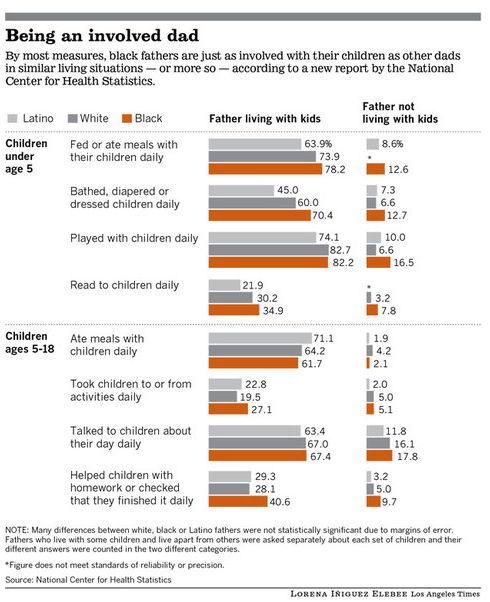
fathers-dayThe Centers for Disease Control and Prevention (CDC) recently published new data on the role that American fathers play in parenting their children. Most of the CDC’s previous research on family life — which the agency explores as an important contributor to public health and child development — has focused exclusively on mothers. But the latest data finds that the stereotypical gender imbalance in this area doesn’t hold true, and dads are just as hands-on when it comes to raising their kids.

That includes African-American fathers.

In fact, in its coverage of the study, the Los Angeles Times noted that the results “defy stereotypes about black fatherhood” because the CDC found that black dads are more involved with their kids on a daily basis than dads from other racial groups:

black-fatherhoodIn some cases, the differences between black fathers and white or Latino fathers weren’t statistically significant. Nonetheless, the fact that there’s no dramatic drop-off for African-American fathers is still a surprising revelation for some people.

Considering the fact that “black fatherhood” is a phrase that is almost always accompanied by the word “crisis” in U.S. society, it’s understandable that the CDC’s results seem innovative. But in reality, the new data builds upon years of research that’s concluded that hands-on parenting is similar among dads of all races. There’s plenty of scientific evidence to bust this racially-biased myth.

Read More The Myth Of The Absent Black Father | ThinkProgress.

Posted in News from the Soul Brother | Tagged , , , , , , | Leave a comment

The Fix Isn’t In: Why a Safety Device That Can Stop Overdoses by Kids Isn’t Widely Used

By T. Christian Miller and Jeff Gerth

tylenolrecall-600x397Starting in 2007, Dr. Daniel Budnitz, a scientist at the Centers for Disease Control and Prevention’s Medication Safety Program, began tracking an obscure but unsettling statistic about children’s health.

Each year, more and more kids were being rushed to emergency rooms after swallowing potentially toxic doses of medication. By 2011, federal estimates put the figure at about 74,000, eclipsing the number of kids under 6 sent to ERs from car crashes.

In most cases, children experienced no lasting harm from accidentally ingesting pills or liquids from the family medicine cabinet, but about 1 in 5 had to be hospitalized for further evaluation. About 20 children died each year from such accidents, CDC data showed.

As an epidemiologist and the father of two kids, including one who had a penchant for putting things in his mouth, Budnitz became fixated on reducing drug overdoses.

In particular, he saw an easy solution for the roughly 10,000 emergency room visits a year involving liquids, such as over-the-counter pain relievers and prescription cough syrups.

It was a type of safety valve called a flow restrictor. The small plastic device fits into the neck of a medicine bottle and slows the release of fluid, providing a backup if caregivers leave child-resistant caps unfastened or kids pry them off.

In 2008, Budnitz persuaded drug makers, federal regulators and poison experts to come together on an initiative to add flow restrictors, which cost pennies apiece, to medicine bottles.

Today, however, that promise to make medicine safer for kids remains largely unfulfilled, hindered by industry cost concerns and inaction by federal regulators, an examination by ProPublica found.

Honoring a pledge made in 2011, drug makers have added restrictors to infants’ and children’s acetaminophen, the active ingredient in Tylenol. That year, roughly one-quarter of kids’ ER visits for drug accidents involved pediatric or adult formulations of acetaminophen.

But the industry has neither promised nor delivered such protection on other medicines, which account for more than half of kids’ ER visits stemming from drug accidents, including antihistamines, ibuprofen, and cough and cold preparations. ProPublica purchased more than 50 pediatric versions of these products marketed by nine different brands at outlets in California, New York and Washington, D.C., this month. None of the products we bought had flow restrictors.

In some instances, companies that have placed flow restrictors on acetaminophen-only kids’ products have not put them on bottles of pediatric cough and cold syrup that contain the same amount of acetaminophen.

Read More The Fix Isn’t In: Why a Safety Device That Can Stop Overdoses by Kids Isn’t Widely Used – ProPublica.

Posted in News from the Soul Brother | Tagged , , , , , , | Leave a comment

How poverty and food insecurity make people sick

By Aimee Picchi

080604_Americans_hungryBeing poor isn’t a lot of fun. For starters, it’s more likely to make you sick by the end of each month.

While government benefits are geared to helping low-income Americans stay healthy by putting food on the table, there’s also a downside to receiving food aid: The money comes in only once a month.

What does that mean for low-income Americans? Many are living off fumes by the time the month winds down, as they count down the days until their next Supplemental Nutrition Assistance Program (SNAP) or Social Security payment arrives.

Unfortunately, that’s taking a toll on the health of poor Americans, who are 27 percent more likely to be hospitalized for hypoglycemia low blood sugar in the last week of the month than in the first, according to new research from the University of California, San Francisco’s Department of Medicine that was published in the January issue of Health Affairs. To be sure, spending down wages and benefits soon after the check arrives is nothing new: The U.S. Department of Labor estimated in 1930 that most factory workers spent between 75 percent to 100 percent of their earnings by the end of the day after payday, the study notes. Aid recipients understand well the need to stretch out assistance to last all month, even if they don’t always manage to do so. Even today, about three-quarters of Americans live paycheck to paycheck.

Read More How poverty and food insecurity make people sick – CBS News.

Posted in News from the Soul Brother | Tagged , , , , , | Leave a comment

The Crisis in Black and Brown Youth Unemployment

By Imara Jones

jobsAs the White House prepares to launch a major economic opportunity effort, record high unemployment among black and Latino youth underscores how essential it is to create job opportunities for young people of color.

The critical issue here is that the ages of 16 to 24 are make or break years for lifelong earning potential. With one out four blacks and one out of six Latinos under the age of 25 without work, a generation of youth of color risks falling behind.

The situation for black and Latino unemployed youths is so alarming that leading think tanks and economists are raising red flags about it at a staggering pace. One report on the topic by Demos, the public policy organization, argues that the “exclusion of young people of color” from job opportunities “weakens the promise of America.”*

Why’s that?

With wealth in African-American and Latino communities already the lowest on record, a loss of income on a generational scale would likely harden existing inequities and set back economic progress in the country for decades. That’s because there are simply so many young blacks and Latinos who want work but can’t find it.

The Older Worker Squeeze

The jumpoff for understanding what’s going on is that the youth jobs market as a whole, like the broader labor market, is in shambles.

With one out six young people without work, youth unemployment is higher than at any point since most people under the age of 25 have been alive. Close to half of the four million young people without work are African-American or Latino. They are joined by another six million young people of all racial backgrounds who have given up looking for work out of frustration.

Read More The Crisis in Black and Brown Youth Unemployment – COLORLINES.

Posted in News from the Soul Brother | Tagged , , , , , , | Leave a comment

Living on $2.13 an hour and tips: the harsh inequality of the service industry

By Jana Kasperkevic

un_dollar_usImagine that your pay depended on the mood of your clients, or on whether all your colleagues and superiors did their jobs well. Food industry workers like Nakima Jones don’t have to imagine this – for them, income instability is a daily reality. Jones is one of 10 million Americans working in food and drink establishments throughout the nation. She knows what’s it like to depend on customers for her rent and grocery money.

Jones, who was born and raised in New York City, has been working on and off in the restaurant industry since she was 16-years-old. Jones recalled some of the hardships of working for tips this week in a panel held by the Ms. Foundation, the Murphy Institute and ROC-New York, which focused on surviving on pay of less than $5 an hour. Among the obstacles she faced were an ever-changing schedule, double shifts and even the fear of going to the bathroom, as she didn’t want to risk giving customers a reason to say she had been inattentive.

Since 1996, the federal tipped-minimum wage for food workers like Jones has been $2.13. So far, only seven states have passed legislation eliminating this kind of sub-wage, requiring all workers to be paid a statewide minimum wage. Some states have taken steps to increase the tipped wage slightly. For example, New York restaurant workers are now paid $5 an hour. Yet many states still pay their food industry workers less than $3 an hour.

This tipped-minimum wage policy is basically the restaurant industry asking its customers to pay its workers, says Saru Jayaraman, co-director of Restaurant Opportunities Centers United, also known as ROC-United, and author of Behind the Kitchen Door.

“When you earn a wage of $2 or $5, you don’t actually earn a wage at all. Your wage is so low it goes entirely to taxes and you get a pay stub that says ‘This is not a paycheck’. It says ‘$0’. And you live off of your tips,” explains Jayaraman. Restaurant workers are also required by law to claim their tips as income. The tax on their combined income – hourly wage plus tips – is considerably more than what they would pay on their hourly pay.

Read More Living on $2.13 an hour and tips: the harsh inequality of the service industry | Money | theguardian.com.

Posted in News from the Soul Brother | Tagged , , , , , , | Leave a comment

Chase

993795_167153233495151_582602492_n

Posted in Soul Brother Presents | Tagged , , , , | Leave a comment

Answer

1170942_700813629933297_1845537205_nP

Posted in Soul Brother Presents | Tagged , , , , , , | Leave a comment

Life

1070005_673519322663075_412141265_n

Posted in Soul Brother Presents | Tagged , , , , | Leave a comment

Confine

1075731_10151567794482781_1012563982_n

Posted in Soul Brother Presents | Tagged , , , , | Leave a comment