
By Menash Demary
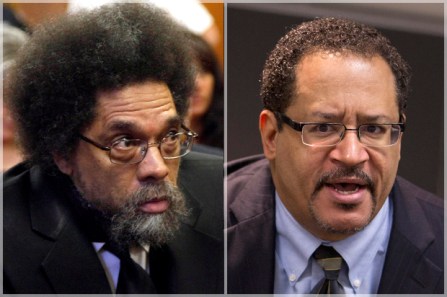
Independent of one’s stance on the rift between Michael Eric Dyson and Cornel West — a rift years in the making and now clearly delineated in the form of Dyson’s essay on West in the New Republic, “The Ghost of Cornel West” — this has all the hallmarks of a messy divorce between two public, black intellectuals who were, perhaps, better served keeping things offline. Maybe try to squash their beef in the privacy of an on-campus office or in a cozy, warm living room with beer or tea shared. Rather, what we have is this: the proverbial tea spilt online, on social media, and I keep asking myself, “Why now? And to what end?”
The essay in question, a veritable bomb lobbed online this past Sunday amid the “Game of Thrones” and “Mad Men” tweets, makes no attempts to hide its intent: The title itself, “The Ghost of Cornel West,” suggests that West, an intellectual powerhouse and elder to many young policymakers, thinkers and writers, is not only in the twilight of his career, but has already passed away, reduced to walking carrion with his relevance trapped squarely in the past. A relic to be remembered and lamented and examined with the white heat of a spotlight meant to sear whatever living, breathing pieces remain of West’s legacy. Dyson — whom West mentored for more than 30 years — wields his pen with career assassination in mind, looking to finish off the man who, once upon a time, Dyson considered to be his friend and, perhaps, much more.
As I said, the very title of the essay foretold ill intent, but before reading it, I had my doubts — or hopes, maybe. I knew in passing of the connection between Dyson and West, and I knew there was a falling out between the two, centered around the rise and eventual inauguration of President Barack Obama. Still, I had my hopes. Maybe the essay—harsh title notwithstanding—would be an open letter of love to Cornel West, last seen being hauled off to a jail cell in Ferguson, Missouri, this past fall. “It could be a plea,” I thought, “for the power and penetrating rhetoric, buoyed by a once-in-a-generation intellect, to return now, now, when we, black Americans, and the nation in whole, need it the most.”




 soulbrotherspeaks.com
Unlike Gwyneth Paltrow, millennials understand the reality of food stamps
By Jana Kasperkevic
photo courtesy of http://foodstampsnow.com
If she was true to her word, Gwyneth Paltrow should be finishing up her food stamp challenge having spent a week trying to survive on $29 worth of food.
Alana Folsom, a twentysomething graduate student, knows something about trying to live on food stamps. One of the so-called millennials, Folsom took an unpaid internship fresh out of college in 2012 and had to rely on food stamps to help supplement her income.
Currently enrolled in graduate school at Oregon State University, Folsom is making do with $800 a month.
“Our stipend just prevents us from being able to apply for food stamps, which is something that a lot of people in my program are upset about because we are living on $800 a month, which is really untenable,” she said, adding that cost of living in Oregon is lower than that of Massachusetts, where she lived in 2012. “Even so, a lot of people are living off student loans, burying themselves in debt or getting money from their parents.”
Back in Boston, she was making about $600 a month working as a dishwasher and server on weekends. The pay barely covered her rent.
“I was following my dreams, which I realized really quickly I could not afford to do. I was working as an intern at the Boston Review [during the week] and was unpaid. I was eating through my savings and applied [for food stamps] because I realized that I was not going to be able to continue pay rent and be able to buy food at the same time,” she said. It was actually Boston Review that had suggested she apply. “I guess other interns they had in the past had done it.”
Read More Unlike Gwyneth Paltrow, millennials understand the reality of food stamps | Money | The Guardian.